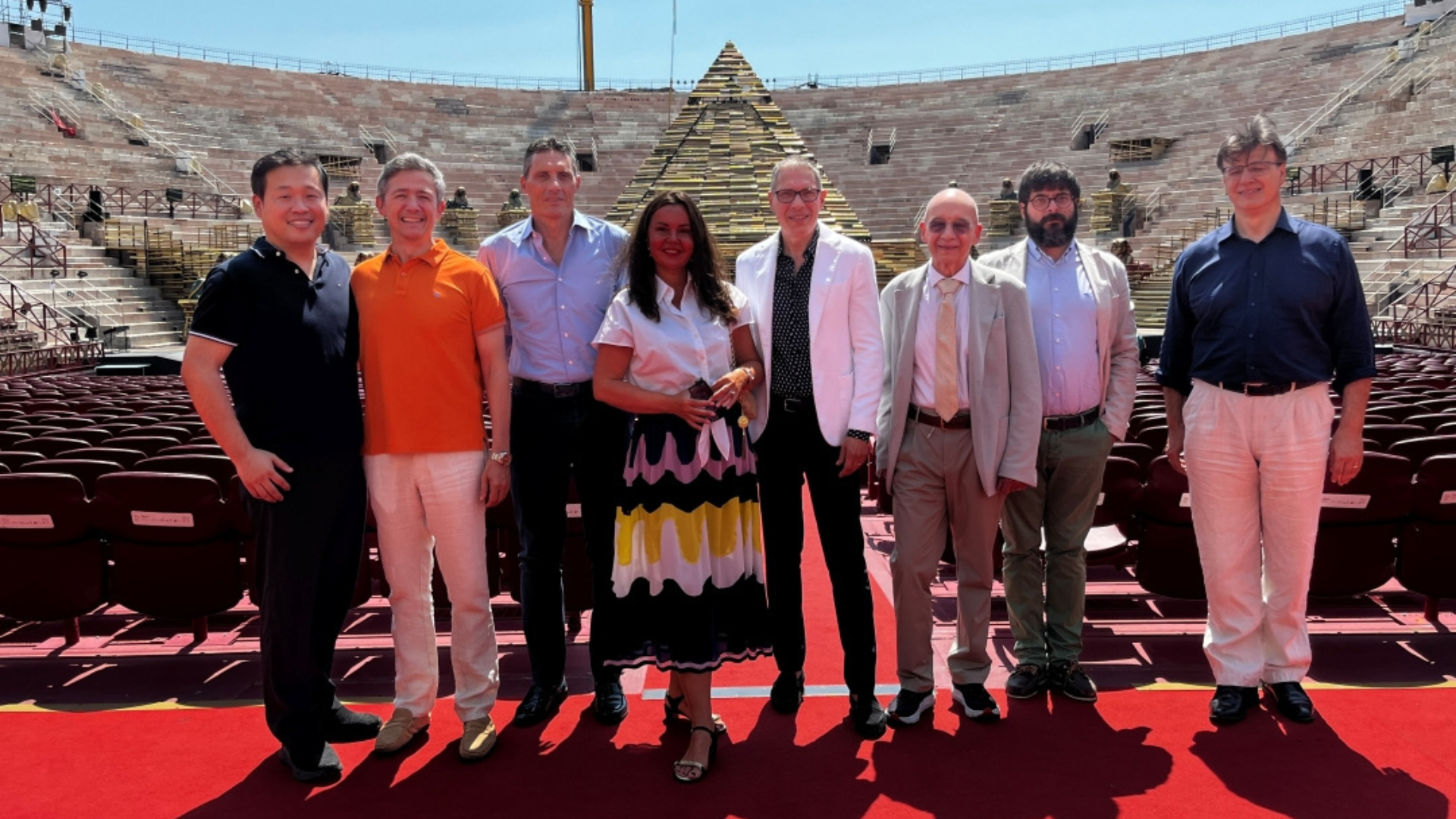
Franco Zeffirelli's golden and sumptuois Aida returns to the Arena
he cast features some of opera’s greatest stars, including Netrebko, Kaufmann, Tezier, Alagna and Kurzak
The Areniana production is on track to reach 1.5 million viewers
AIDA by Giuseppe Verdi
30 July at 9.15 pm
9, 15, 23 and 30 August at 9.00 pm
4 and 10 September at 9.00 pm
Same title, new cast, new production. From 30 July, the Arena di Verona will once again stage Aida, the most beloved and frequently performed opera at the Amphitheatre, in a second production. After crystal, it will be gold that dazzles the audience at the 103rd Opera Festival, in this sumptuous production directed and designed by Franco Zeffirelli, with costumes by Anna Anni and choreography by Vladimiri Vasiliev. Taking to the stage will be Kurzak, Alagna, Siri, Eyvazov, Netrebko, Kaufmann, Tézier, Margaine, Vinogradov and Baek, just some of the opera stars, alongside eagerly awaited debuts, who will take turns on the Arena’s immense stage under the baton of Maestro Ommassini. The opening night is already sold out, with a further six performances until 10 September.
The opera that launched the Arena di Verona Opera Festival in 1913 has, over the course of a century, become the most beloved and frequently performed opera at the Amphitheatre, having been staged a total of 783 times. And, following the run of Poda’s production, which took centre stage in June and July, the second half of the summer will showcase a golden Egypt, imbued with multicoloured stones and precious fabrics, as imagined by Zeffirelli.
Zeffirelli returned to Aida at the Arena in 2002, presenting his third production for the amphitheatre. Ancient Egypt is depicted here in a mythical, almost fairy-tale-like light, moving away from the potential simplistic clumsiness of the ‘peplum’ genre to take on the radiance of gold. Gold is light and power in the halls of Memphis, but the majestic facades of the central pyramid (with scene changes as swift as they are silent) can become shadowy expanses of dunes in the moonlight, mysterious walls of palaces and inaccessible temples from which mysterious clouds of incense rise. Enriching this interplay of light and shadow are a thousand shades of colour, reminiscent of the precious stones in which the sphinxes are carved, or of fine linens and silks, in the costumes designed by the reliable and award-winning collaborator Anna Anni.
The settings change rapidly, and Zeffirelli’s staging, with its skilful use of light, manages to draw every spectator’s gaze, just as in the finest cinematic productions, from the public realm of crowded squares to intimate monologues, prayers, declarations of love and secrets of war. Following its initial run until 2006, the production has only returned to the Festival’s programme in 2010, 2015, 2018 and 2022. Starting on 30 July, it will return to the stage for the 2026 Festival, featuring choreography by Vladimir Vasiliev and hundreds of chorus members, dancers, Egyptian trumpeters, mimes and extras.
The Fondazione Arena Orchestra and Chorus (prepared by Roberto Gabbiani) will be conducted by the maestro Francesco Ommassini. A veritable cast of stars: for three evenings the title role will be played by Aleksandra Kurzak, accompanied by newcomer tenor SeokJong Baek (30 July) and her partner both on stage and in life, Roberto Alagna (9 and 23 August).
For one exceptional evening only, Anna Netrebko will play the Ethiopian princess on 30 August. Meanwhile, on 10 September, Jonas Kaufmann, the king of tenors, makes his grand return in the role of Radames. Maria José Siri will play Aida for a further two performances (marking her 200th performance in the role), alongside Yusif Eyvazov and Paolo Lardizzone as Radames, whilst Clémentine Margaine will be the sole Amneris, and Youngjun Park will play Amonasro (with the exception of the performance on 30 August, when the role will be played by Ludovic Tézier). Alexander Vinogradov and Simon Lim will be replaced as High Priest Ramfis by the bass Gianluca Buratto.
Rounding out the cast are Abramo Rosalen and Mariano Buccino (King of the Egyptians), Carlo Bosi and Riccardo Rados (Messenger), Francesca Maionchi (High Priestess), as well as principal dancers Eleana Andreoudi and Ionuţ-Andrei Diniţă, soloists with the Arena Ballet coordinated by Geatano Petrosino, and Tea Bajc as Akmen, a role created by Zeffirelli in 2002 specifically for Carla Fracci, the guiding spirit who accompanies the opera’s protagonists through the fateful events that await them.
Following the first, sold-out performance on 30 July, Aida will be performed again on 9, 15, 23 and 30 August and on 4 and 10 September at 9.00 pm. Tickets are available on the www.arena.it website, across social media channels, at the Arena ticket offices and via the Vivaticket network.
The plot. While war rages on Egypt's borders, in Memphis the young captain Radamès is torn between love of Amneris, daughter of the Pharaoh, and his mutual passion for the slave girl Aida (also a princess, as daughter of the Ethiopian King, Amonasro). The oracle appoints Radamès to lead the army against Aida's people. The battle is won by the Egyptians, and Amonasro is brought to the capital among the Ethiopian prisoners. He conceals his royal identity and is granted clemency but secretly forces his daughter to compromise her beloved young captain.
During a nocturnal tryst between the two lovers, Radamès, who has been promised in marriage against his will to Amneris, unintentionally reveals a military secret. Flight would offer both safety and dishonour, but Amneris discovers them. While Aida and her father escape, the young captain remains behind. He is sentenced to death for treason despite the princess's attempts to sue for mercy from the priests. Aida, who was thought to have fled, manages to hide in the crypt of the temple where Radamès is buried alive. In the end, all they can do is hope for a better afterlife together.