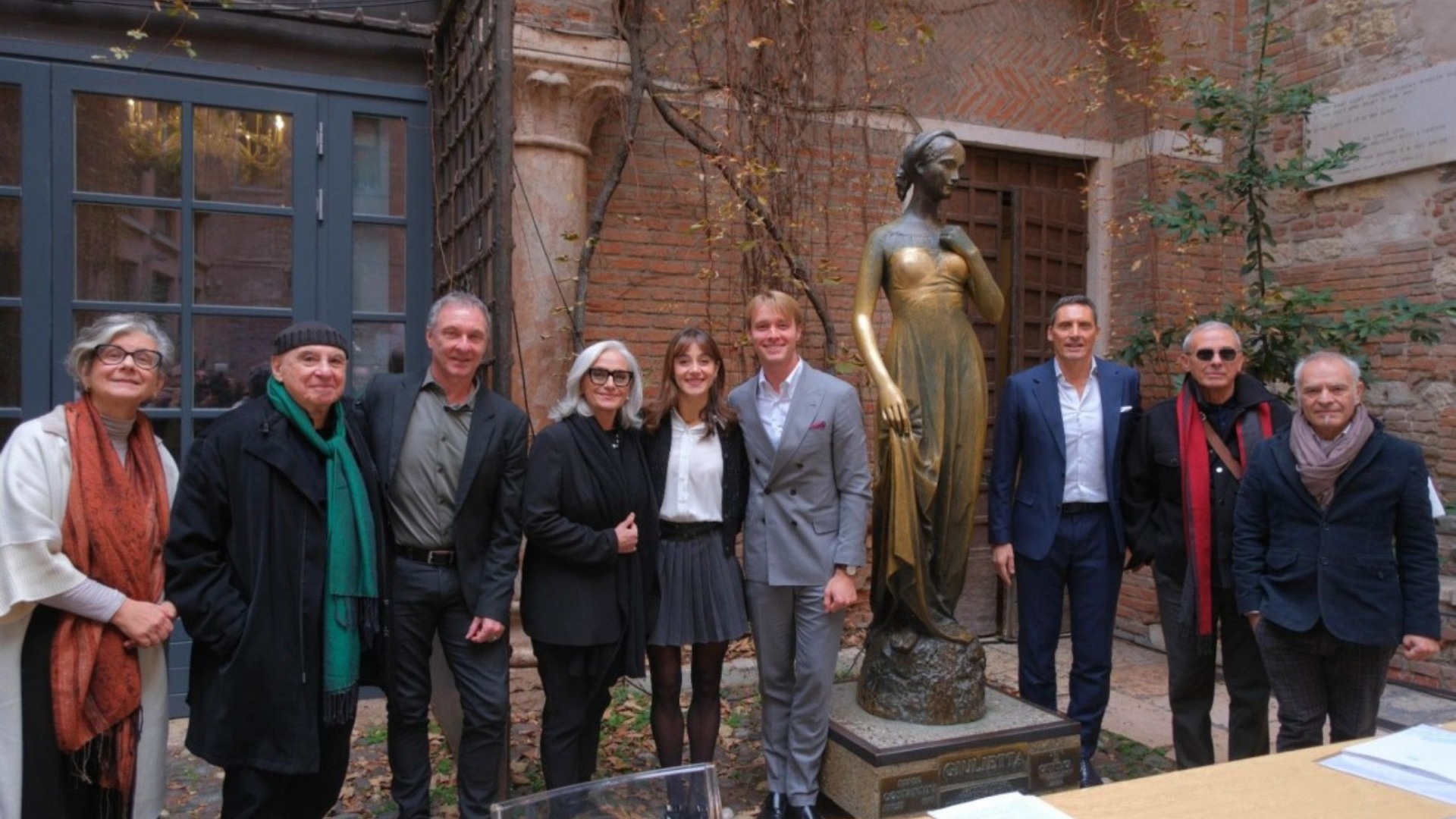
Romeo and Juliet in the Arena for the 2027 Festival. Ballet with an orchestra returns to the Amphitheatre for the first time in 34 years
Sets by Franco Zeffirelli, based on the original sketches created for the 1964 theatre production at the Teatro Romano, and costumes by Maurizio Millenotti.
Nicoletta Manni and Timfoej Andrijashenko star in Prokofiev’s masterpiece, with new choreography by Manuel Legris.
Sets designed by Franco Zeffirelli, based on sketches drawn for a stage play at the Teatro Romano in 1964, and costumes by Maurizio Millenotti
Romeo and Juliet is the ultimate love story – the timeless myth immortalised by Shakespeare, which has made Verona famous all over the world. Just like the Arena, the universal symbol of the city and the venue for a century-old Festival. Two icons, a shared international vocation, which in the summer of 2027 will come together in an exceptional project, entrusted to the vision and talent of the great masters and leading figures of Italian culture.
The Fondazione Arena di Verona has chosen Prokofiev’s world-famous creation to bring grand ballet back to the Amphitheatre in its complete form for the Opera Festival 2027, for the first time in 34 years. Featuring étoiles of ballet and a magnificent new production that will be brought to life from Franco Zeffirelli’s sketches – drawings rediscovered at the Zeffirelli Museum by the Foundation of the same name, originally created for the Shakespearean theatre tour that began in Verona’s Teatro Romano in 1964. From 18 June 2027, the ballet Romeo and Juliet will be staged for four unmissable evenings, one of which will be accessible as part of the new Arena per Tutti 2027 project.
The countdown has begun. Full-length ballet performances have not been staged at the Amphitheatre since 1993’s Spartacus. Romeo and Juliet was staged in 1955, 1971, 1982 and 1991, as well as in two productions at the Teatro Romano and the Teatro Filarmonico in 1998 and 1999. In recent seasons, dance has really come to the fore. Following the success of Zorba the Greek, which the Fondazione Arena staged for four summers at the Teatro Romano, and the ballet productions at the Filarmonico – including Swan Lake, Jeu de cartes, Pinocchio and The Nutcracker, scheduled for next year – the Fondazione Arena is bringing the great tradition of ballet back to the Arena.
The production will be in the hands of choreographer Manuel Legris, a former Parisian étoile hand-picked by Nureyev himself, who went on to serve as director of the Vienna State Ballet for ten years and of the corps de ballet at the Teatro alla Scala in Milan for a further five.
Taking centre stage on pointe, alongside the Arena Dance Troupe coordinated by Gaetano Bouy Petrosino, are two of today’s international stars, a couple both on and off stage: Nicoletta Manni and Timofej Andrijashenko, Étoile and Principal Dancer respectively at La Scala. Both artists owe a great deal to this very ballet: in 2022, in an Arena packed to the rafters for the ‘Roberto Bolle and Friends’ evening, after performing the balcony scene from Prokofiev’s ballet, they became engaged in a surprise proposal, to a standing ovation from the audience in the Amphitheatre.
The staging will be of outstanding quality. The vast stage beneath the stars and the millennia-old tiers of the Arena will host a first-ever reconstruction of Franco Zeffirelli’s sketches, created for the stage production of Romeo and Juliet staged at the Teatro Romano in Verona in 1964. The Florentine maestro tackled the story in a revolutionary way both on stage and on screen, first in 1960, captivating London’s Old Vic and the Shakespearean theatre scene of the time with action and realism (and, amongst other things, launching the rising star Judi Dench), before revamping the production for Verona’s Teatro Romano in 1964 – the first stop on a two-year international tour (starring a young Giancarlo Giannini and Anna Maria Guarnieri), and finally immortalising his own interpretation – a blend of tenderness, youth and sumptuousness – in the 1968 film starring Olivia Hussey and Leonard Whiting. This vision of Shakespeare’s classic tale – not as an aesthetic testing ground but as living, pulsating theatre – changed the way theatre was made in the United Kingdom and beyond forever, astonishing – and winning over – audiences and critics alike. A beauty at the service of drama, which would return multiple times during the decade Zeffirelli dedicated to straight theatre (the 1960s). Decades later, he contemplated bringing it back to the stage for the public, though this was never realised. It remained unique, unmatched even by the numerous 19th- and 20th-century adaptations that resulted in major operas and ballets.
Thanks to the support of the Zeffirelli Foundation, which made available previously unpublished sketches and drawings for the ballet and the Arena, and to the collaboration of set designer Carlo Centolavigna, the Fondazione Arena will bring to life the mythical, Renaissance-era Verona of the Florentine maestro, with scenes of youthful escapades and monumental vistas, exactly as Shakespeare imagined the city, and within the amphitheatre which Zeffirelli had loved ever since 1995, a love shared with millions of spectators from all over the world.
The costumes will be designed by another contemporary master, Maurizio Millenotti, a multi-award-winning costume designer for theatre and cinema, a frequent collaborator with Franco Zeffirelli on his final outstanding and ambitious productions (such as Don Giovanni and La Traviata for the Arena), who has only worked on dance productions on a few, very select occasions.
The music will be performed live, in the pit, by the Fondazione Arena Orchestra. Among the hundreds of artistic interpretations of Shakespeare’s play, Prokofiev’s ballet Romeo and Juliet stands today as one of the pinnacles of musical history, as well as of dance. The immortal notes, combining accentuated rhythms, iridescent timbres, surprising effects and melodic flourishes of seductive lyricism, make this work – even in concert performances of the three different suites drawn from it by the composer – a much-anticipated test for performers and conductors.
Sergei Prokofiev (1891–1953) composed Romeo and Juliet at the dawn of a new phase in his career as a composer, pianist and conductor; formerly an avant-garde figure verging on the provocative, he was seeking a more melodic style, as evidenced by the Second Violin Concerto and the musical fairy tale Peter and the Wolf, two of his works that remain among the most frequently performed in the international repertoire to this day. A composer in great demand internationally, Prokofiev, on the hunt for a lyrical subject, received a proposal from the St Petersburg Theatre (not yet the Kirov), which later became a formal commission from the Bolshoi in Moscow. Although the score had already been completed in 1935, the premiere was postponed several times because, at the time, the dancers “were not used to music of this kind; indeed, they were even afraid of it”, in the words of the legendary Galina Ulanova, whose fame stems precisely from her starring role in the production. Success for this four-act ballet came rather late for Prokofiev, given that the premiere took place only in 1940 and following an initial performance in Brno, far removed from the spotlight of Russian art, which was, moreover, under the strict control and censorship of the Soviet regime.
Prokofiev’s score, performed in its entirety live at the Arena di Verona, therefore represents an unmissable opportunity not only for lovers of classical ballet and dance in general, but also for music enthusiasts.
Following the eagerly awaited premiere on 18 June 2027, Romeo and Juliet will be performed on three further evenings: 26 June, 15 July and 20 August.
Romeo and Juliet will be an accessible production. The performance on 15 July will, in fact, be included in the programme for the fifth edition of ‘Arena per Tutti’, the accessibility project developed by the Fondazione Arena in partnership with Accessibility Partner Müller, which enables people with cognitive and sensory disabilities to enjoy an evening’s performance at the Arena thanks to dedicated support measures such as accessible programme booklets, simplified Easy-to-Read performance sheets, subtitles, audio description and special pre-performance tours, such as the dance tour successfully launched in 2026.
The new production of Romeo and Juliet is just one of the highlights of the packed 2027 season, which will open with a special gala evening on 11 June. There will be five opera productions, featuring the return of the Festival’s most recent productions, with Verdi again in the spotlight. These will include La Traviata, directed by Paul Curran and produced in collaboration with the Moulin Rouge in Paris, and the ‘atomic’, technological and symbolic Nabucco interpreted by the multi-talented Stefano Poda. And, of course, Aida will return in two different guises: Gianfranco de Bosio’s historical staging, inspired by the first Arena production in 1913, and the ‘crystal’ edition created for the 100th Festival by Stefano Poda. Bizet’s Carmen will also return in Franco Zeffirelli’s sumptuous production, a record-breaking show loved all over the world. The Arena’s summer under the stars will also feature galas and special events: Roberto Bolle and Friends will return featuring the cream of the dance world, on two exceptional dates – 8 and 21 July – in co-production with ARTEDANZAsrl. Moreover, the world-famous Four Seasons will feature in the immersive show Viva Vivaldi, co-produced with Balich Wonder Studio, on 24 August, while the brand-new Paganini Paradise will include some truly virtuoso performances on 25 August. Opera mega-star Jonas Kaufmann will renew his ties with the Arena in a gala show on 8 August, while Orff's Carmina Burana will return on 29 August with a large ensemble of orchestra, chorus and children’s choir.