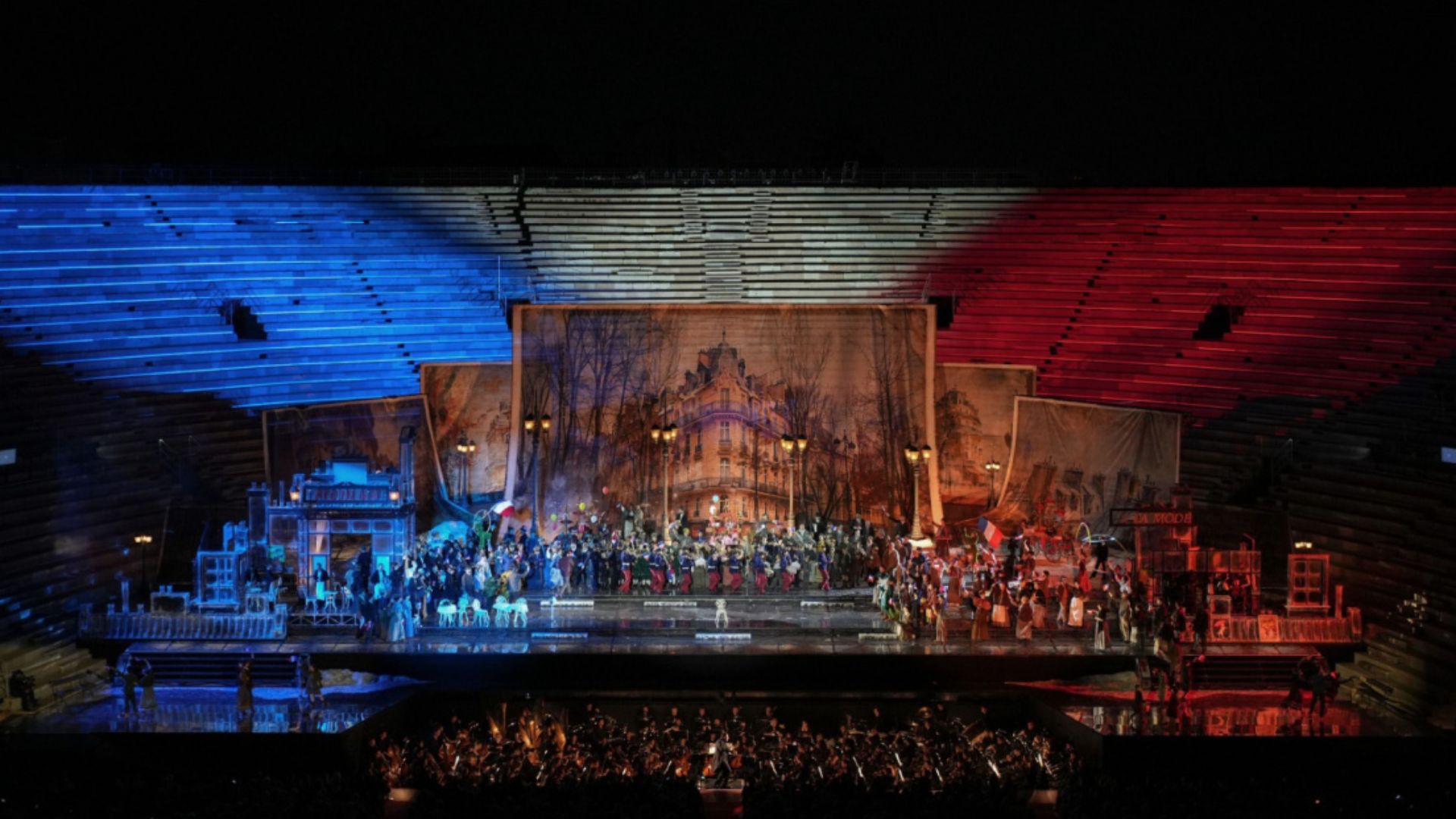
La Bohème brings love, friendship and youth to the Arena
Buratto, Eyvazov, Damian, Roslavets, Antem, López Moreno, Barbera: an international cast of stars conducted by Maestro Lanzillotta, making his debut at the Arena
3 to 25 July: four exceptional evenings for Puccini's masterpiece
As the fourth opera of the 103rd Arena di Verona Opera Festival, La Bohème takes to the stage for just four evenings from 3 to 25 July. An exceptional cast features Eleonora Buratto and Yusif Eyvazov performing the roles of Mimì and Rodolfo at the Arena for the very first time, alongside Mihai Damian, Alexander Roslavets and Jan Antem. Alternating in the cast are Carolina López Moreno and René Barbera. Making his debut on the Arena podium is Francesco Lanzillotta. The production is that with which the Arena most recently paid tribute to the centenary of Puccini’s death, featuring direction by Alfonso Signorini and sets by Juan Guillermo Nova. Through clever transparencies and visible scene changes, realistic glimpses of real life in mid-19th-century Paris emerge, brought to life by hundreds of chorus members, mimes, dancers, extras and a children's choir. Subsequent performances will take place on 11, 17 and 25 July, all at 9.15 pm.
Camaraderie, laughter, budding romance and lifelong friendships – La Bohème captures all of this in an eternally youthful work, powered by Puccini's most inspired and deeply moving music. It is a 'perfect' opera where emotion, humour and energy seamlessly coexist, featuring some of the most beautiful melodies and most celebrated, beloved arias of all time. La Bohème had been absent from the Arena for thirteen years when this new production was introduced in 2024 to celebrate the centenary of the death Giacomo Puccini. It returns this Friday, 130 years after its world premiere, conducted by a young Toscanini.
Based on Murger's novel Scenes of Bohemian Life, the opera immortalises the dreams, friendships, romances, heartbreaks and personal growth of six penniless youngsters. These everyday, deeply human stories are elevated to unforgettable heights by Puccini's music and theatrical instinct, retaining all their honesty and relevance today.
Bringing this story to life for the Arena audience, while remaining completely faithful to Illica and Giacosa's libretto, is journalist, music lover and veteran opera director Alfonso Signorini, collaborating with the experienced set designer Juan Guillermo Nova, who also created this year’s inaugural La Traviata. The staging is historically faithful and constructed using transparent materials to reveal multiple levels of action and allow the audience to witness the characters' daily lives even before the fateful encounters that will alter their paths forever. The same meticulous attention to detail has been poured into the costumes, coordinated by the Arena’s own Silvia Bonetti, with historical cuts that evoke France between 1860 and 1890, perfectly aligned with the directorial vision.
Puccini's opera first saw the light of day in 1896, following three years of work that were also marked by a feud with Leoncavallo – author of the famous Pagliacci – who was setting the exact same subject to music. Puccini's passion for the story was deeply authentic and autobiographical. He channelled the very best of his melodic talent, orchestrating skill and infallible theatrical instinct into the work, inspired by memories of his own difficult years as a student in Milan, when he would share dreams, hopes, disappointments and hardships with his roommate Mascagni, another future successful composer. The success of Puccini's opera completely overshadowed his colleague's version, and following its Turin premiere, La Bohème continued its triumphal march across stages around the world, eventually conquering cinema as well. At the Arena, it stands as the eleventh most frequently performed title of all time, staged 80 times since 1938 and featuring legendary performers such as Di Stefano, Tebaldi, Lugo, Scotto, Bastianini, Stella, Aragall, Pavarotti, Gasdia, Vinco, La Scola, Cedolins, Alvarez, Grigolo and many others.
Some truly great singers, already acclaimed at the Arena, are adding a new character to their Festival repertoire. Eleonora Buratto will portray Mimì for the first two performances, alternating with Carolina López Moreno in her Arena debut. Yusif Eyvazov will step into the role of Rodolfo for the first time for three evenings, with René Barbera taking over on 25 July. The tight-knit circle of friends in the bohemian attic will be played across all performances by Mihai Damian (the painter Marcello), Alexander Roslavets (the philosopher Colline, making his Arena debut) and Jan Antem (the musician Schaunard). Two sopranos will alternate as Musetta for two evenings each: Francesca Pia Vitale (3 and 11 July) and, making her Arena bow, Enkeleda Kamani (17 and 25 July). In the supporting roles are Nicolò Ceriani, Gianfranco Montresor, Carlo Bosi, Matteo Macchioni, Nicolò Rigano and Maurizio Pantò. The stage will come alive with hundreds of mimes and extras, members of the Arena Ballet coordinated by Gaetano Petrosino, the Fondazione Arena Chorus, prepared by Roberto Gabbiani, and the young voices of the A.Li.Ve. children's choir, prepared by Paolo Facincani. There is also a debut for Francesco Lanzillotta, who has already garnered great acclaim at the Teatro Filarmonico at the helm of the Orchestra of the Fondazione Arena and is now ready to conduct his very first production at the Amphitheatre.
Following the opening night on Friday 3 July, La Bohème will be performed on Saturday 11, Friday 17 and Saturday 25 July at 9.15 pm. Tickets are available on the www.arena.it website, across social media channels, in the Arena di Verona ticket offices and via the Vivaticket network.
The plot. In Paris, four young men with little money but grand dreams share a deep friendship and a tiny attic room: Rodolfo writes to make a living, Marcello paints, Schaunard teaches music and Colline is a philosopher. On Christmas Eve, they manage to outsmart their landlord to avoid paying the rent and head out to enjoy themselves in the Latin Quarter. Rodolfo stays behind for a moment and receives a visit from Mimì, a poor and beautiful young neighbour living in the same building, who needs help finding a light for her candle. It is love at first sight. Out in the square, the friends raise a toast, joined by Mimì and soon by Musetta, Marcello's ex-girlfriend, though not before she publicly arouses his jealousy once again while a festive military parade marches by. A few months later, the first cracks begin to show. Having left their room, Rodolfo confides in Marcello that he wants to leave Mimì solely to guarantee her a better future – the young girl is suffering from tuberculosis, and the hardships of their poverty are worsening her condition. However, Mimì has followed him and overhears everything. Still deeply in love, the two decide to delay their parting. At a later point, both couples break up, but the paths of the four friends, Musetta and Mimì are set to cross one final time.