The seasonal debut for the visionary show created by Stefano Poda: Nabucco is "atomic" in Arena from 26 June
Ten performances throughout the summer featuring an international cast conducted by Michele Spotti
The 103rd Arena di Verona Opera Festival is expanding its schedule with its third production: Nabucco
The 103rd Arena di Verona Opera Festival is expanding its schedule with its third production: Nabucco – Verdi's choral drama par excellence – debuts on 26 June at 9.15 pm for ten evenings, featuring major international voices under the baton of Michele Spotti. Enkhbat, Siri, Stroppa, Tagliavini and Salas will take to the stage for the opening night. Alternating in subsequent performances will be Tézier, Park, Salsi, Maslova, Torbidoni, Werle, Lim, Vinogradov, Pertusi, Meli and, from August, Sebastiano Rolli making his debut on the Arena podium. The show, which opened the 2025 Festival, features direction, sets, costumes, lighting and choreography by Stefano Poda, using powerful symbols to depict a humanity fractured by conflict and dualities, yet on a collective quest for reconciliation.
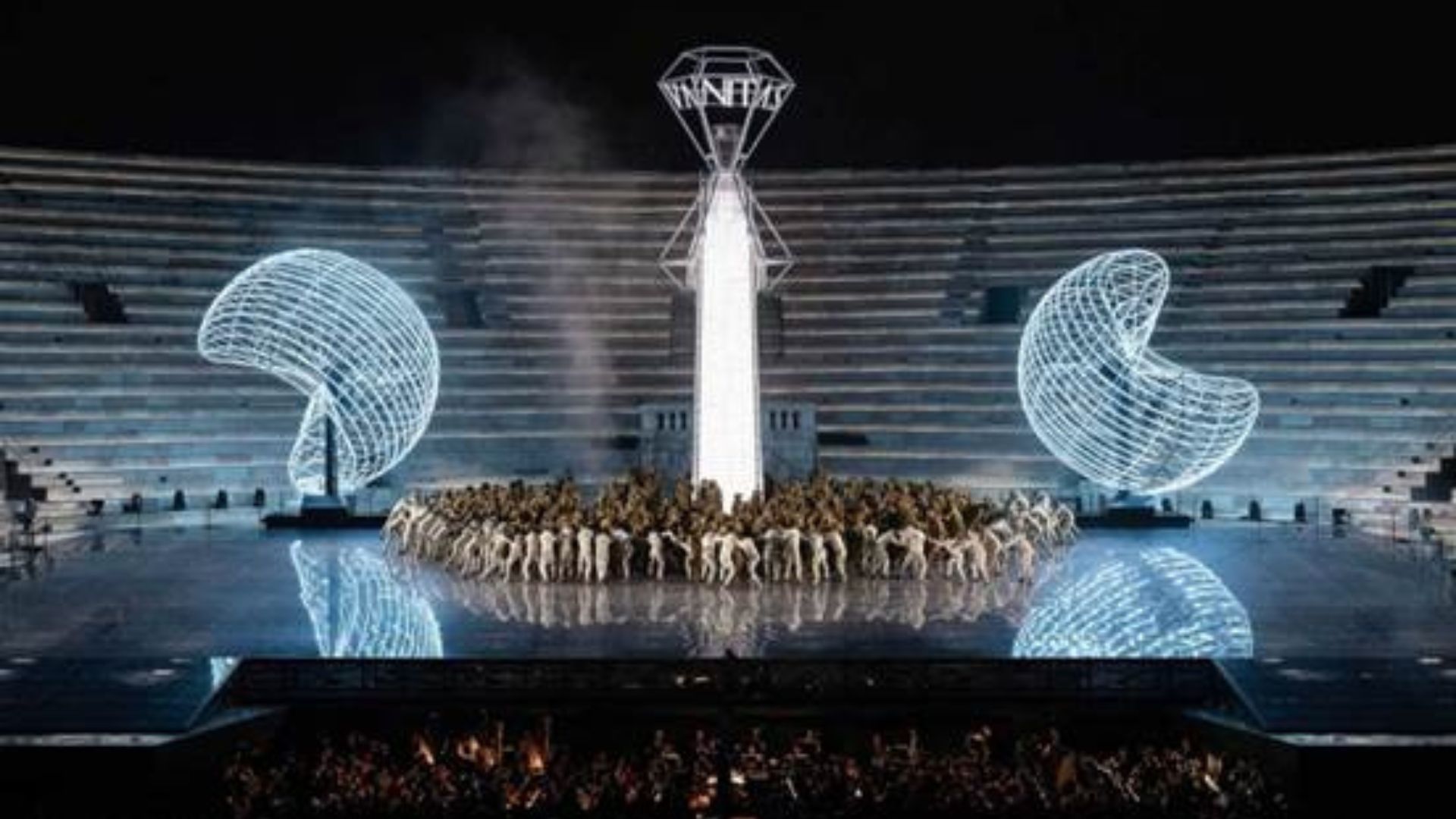
Two hemispheres of light, like two subatomic particles, that attract and repel each other, with the power to create and destroy; a large inclined plane that becomes a labyrinth in which to lose and ultimately rediscover oneself; two peoples contrasting in colour and garb, divided into two opposing factions. And, lastly, a steep, towering staircase dominated by the hourglass of time. These diverse elements encapsulate the entire story of Nabucco: war, deportation, love, ambition, conversion and, finally, the restoration of peace. With its powerful symbolism, this is the collective history of Nabucco according to Stefano Poda, the production that launched the 2025 Festival and was also recorded by Rai and Unitel for an audience of millions.
As the third title of the 2026 Festival, Nabucco takes to the stage from Friday 26 June at 9.15 pm and, alongside the other titles on the programme, runs until 9 September, featuring two different conductors and some of the finest voices on the international stage. Starring in the title role for the opening performances is baritone Amartuvshin Enkhbat, alternating with Ludovic Tézier (12 July), Youngjun Park (18 and 23 July and 8 August) and Luca Salsi (1 August and the final three performances). The role of Abigaille is among the most challenging ever written for a soprano: she will be portrayed in Verona by Maria José Siri, alongside Olga Maslova (23 July and 8 August) and Marta Torbidoni (20 and 28 August). Written for a mezzo-soprano is the role of her sister Fenena, portrayed by Annalisa Stroppa (26 June, 4 and 18 July and 9 September) and Anna Werle (12 and 23 July and 1, 8, 20 and 28 August), both making a highly anticipated return to the Arena. A series of leading basses will tackle the role of the prophet Zaccaria: Roberto Tagliavini will be followed by Simon Lim (4, 12 and 23 July), Alexander Vinogradov (18 July and 8, 20 and 28 August) and Michele Pertusi (9 September). The tenor Galeano Salas will play playing Ismaele, alternating with Francesco Meli (18 and 23 July and 1 and 8 August) and Paolo Lardizzone (20 and 28 August). In the supporting roles, Nicolò Ceriani and Gabriele Sagona play the High Priest of Baal; Carlo Bosi, Riccardo Rados and Matteo Macchioni portray Abdallo, the loyal captain of Nabucco's guards; and sopranos Elisabetta Zizzo ed Elena Borin play Anna, Zaccaria's sister.
Following the success of the opening La Traviata, thirty-three-year-old Michele Spotti, already director in Marseille and soon to take up a post in Berlin, is returning to the Arena to tackle this title at the Amphitheatre for the first time, conducting the first six performances. On 8 August, the baton passes to Sebastiano Rolli, one of the leading experts in the performance practice of early 19th-century Italian opera. The Fondazione Arena Chorus, prepared by Roberto Gabbiani, makes a vital contribution throughout the work. In addition to the artistic ensembles on stage, this production of Nabucco also relies heavily on the Arena's technical crew for a staging that extends across all the ancient stone tiers of the Arena and rises even above the highest row.
"With this opera, it can truly be said that my artistic career began," was Verdi’s own view of Nabucco. Verdi's third operatic venture recounts a rebirth even within its own genesis: that of the composer himself following the worst crisis of his life. In the space of a few short months, he had seen his only comic opera fail under the whistles of the Milanese public, alongside the tragic loss of his wife and both his infant children. Having decided to retire from musical life, he received a new libretto from the impresario Merelli that had just been rejected by the composer Otto Nicolai. This was Nabucodonosor, which Temistocle Solera had adapted from a play by Anicet-Bourgeois and Cornu and a ballet by Cortesi, as well as from the Old Testament. Indifferent and disheartened, Verdi threw the libretto aside and it flew open at the lines "Va, pensiero, sull'ali dorate" ("Fly, thought, on golden wings"). Since its 1842 premiere, the success of Nabucco has never waned, nor has Verdi's star.
The opera first arrived at the Arena in 1938 and is today the third most frequently performed work in the history of the Festival, with 251 performances across 27 seasons and 13 different stagings. The version crafted by Stefano Poda is the most recent, as well as the most technologically challenging ever seen. It features innovative fabrics, unique materials for the costumes, which utilise kilometres of LED lights, and fencing choreography for hundreds of dancers, mimes and extras duelling to the thrilling crescendos of Verdi's score. Following the premiere on Friday 26 June, Nabucco will be performed on 4, 12, 18 and 23 July at 9.15 pm, and on 1, 8, 20 and 28 August and 9 September at 9.00 pm. Tickets are available on the www.arena.it website, across social media channels, at the Arena ticket offices and via the Vivaticket network.