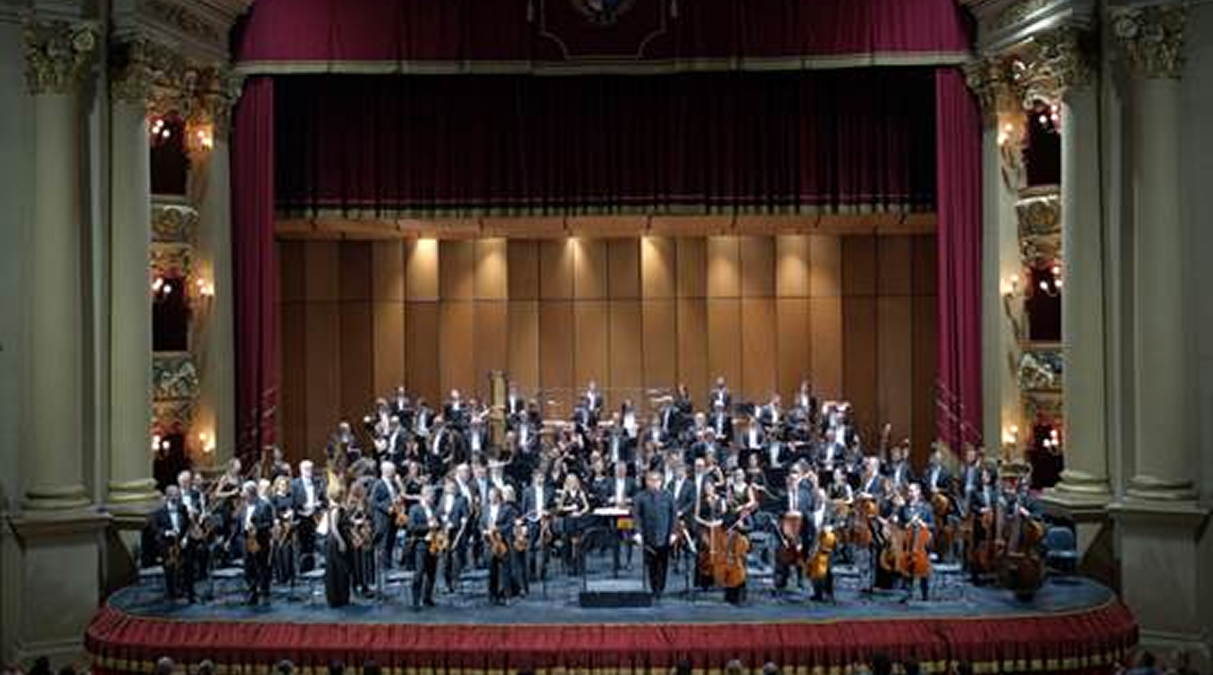
The song of farewell: for the first time the Fondazione Arena Orchestra performs Mahler's last symphony
The premiere on Friday, April 24 at 8 PM, repeated on Saturday, April 25 at 5 PM
On the podium, Maestro Lü Jia conducts the Ninth Symphony
An intense, poignant, and deeply moving work, the Ninth Symphony is also the last that Gustav Mahler managed to complete. For the first time, the Orchestra of Fondazione Arena will perform it in the concert conducted by Lü Jia on Friday 24 and Saturday 25 April at the Teatro Filarmonico in Verona.
MAHLER 9 Jia
Friday 24 April 8:00 PM
Saturday 25 April 5:00 PM
Teatro Filarmonico di Verona
Between ironic dance steps, fierce recalls, references to Beethoven, and intense string chorales, there is a whole world in Gustav Mahler's Ninth Symphony: it is the composer’s - and highly sought-after conductor's - farewell to Vienna and a period of crisis, but also the summation of his previous works. A 'cursed' Ninth, which would remain his last completed symphony and which, for the first time with the artistic ensembles of Fondazione Arena, will resonate in the hall of the Teatro Filarmonico under the direction of Lü Jia in an unmissable double appointment, Friday 24 April at 8 PM and Saturday 25 April at 5 PM.
He defined himself as «three times homeless: a Bohemian among Austrians, an Austrian among Germans, and a Jew among all the peoples of the world»: Gustav Mahler (1860-1911) was already an established conductor by 1908, following ten years of managing the Vienna Imperial Opera, his adopted city. In the capital of the Austro-Hungarian Empire, he met Alma Schindler, who would become his wife and mother of two daughters. However, in 1908, Mahler found himself in the position of an exiled artist, forced to start a new life with his family due to his appointment at the Metropolitan Opera in New York (soon 'displaced' by Toscanini) and a new summer residence. This was the only period when the busy conductor could write his own music, following the loss of his first daughter. In Toblach, from 1908, Mahler composed The Song of the Earth (a symphony of lieder), the Ninth Symphony, and the first sketches of the Tenth, which remained unfinished. A drastic decline in health brought him back to Europe one last time, forever. All his final works seem to summarize his previous artistic journey, combined with a lyricism more intense than ever and the recurring theme of farewell—of detachment from worldly things.
A painful and suffered detachment, which takes shape in the Ninth Symphony in an original way between traditional forms and personal innovations. There are four movements, as in the classic sonata form, but unusually, the opening consists of two slow movements: the rich and complex initial Andante comodo – defined by Alban Berg as Mahler’s finest creation – and the final Adagio, which links back to the late works of Tchaikovsky and Bruckner. In between are two 'scherzos': the lively series of Ländler (the folk ancestor of the waltz) in the second movement, and the diabolical Rondo-Burleske, where the composer mockingly dedicates a wild dash of dense counterpoint and virtuosic orchestration to the artistic establishment. The core from which the entire Ninth Symphony sprouts is the three descending notes of the Les Adieux sonata, Mahler's favorite, upon which Beethoven himself wrote the three syllables “Lebewohl”: farewell.
An intense work, a journey into the soul that culminates in an ethereal finale projected into silence, which the Orchestra of Fondazione Arena will tackle for the first time on Friday 24 April at 8 PM at the Teatro Filarmonico, with a repeat performance on Saturday 25 April at 5 PM. Conducting is Lü Jia, an esteemed maestro with an international career, frequently applauded in Verona, where he began his journey toward the complete Mahler cycle.
Before this weekend, Mahler’s Ninth Symphony had been performed only once in the history of Fondazione Arena, in 1993, by the prestigious London Philharmonia Orchestra, guest-led by its conductor Giuseppe Sinopoli. Fondazione Arena di Verona dedicates this concert to him, a great Mahlerian interpreter, on the twenty-fifth anniversary of his untimely passing.
The 2026 Symphonic Season features four other double-date appointments between May and November, with internationally renowned conductors and soloists performing great classics from the 19th century to today, several premieres for Verona, and world premieres commissioned by Fondazione Arena: season tickets and single tickets for each date can be purchased at the link https://www.arena.it/it/teatro-filarmonico, at the Arena Box Offices, and through the Vivaticket network.
BCC Veneta is the main sponsor of the 2026 Artistic Season of Fondazione Arena at the Teatro Filarmonico.
EVENTS FOR YOUTH AND STUDENTS. The 2026 Arena Young programming also includes the entire Symphonic Season. Every Friday, for the series Andiamo a teatro (Let's go to the theatre), schools can attend concerts at reduced rates and participate in the Prelude one hour before the show: an introduction to the plot, characters, and language of musical theatre, curated by Fondazione Arena. Info and reservations: Education, Culture, and Training Office scuola@arenadiverona.it – tel. +39 0458051933
ARENA DI VERONA BOX OFFICES
Via Dietro Anfiteatro 6/b
Open Monday to Friday (10:30 AM - 4:00 PM)
Saturday (09:15 AM - 12:45 PM)
Closed on Sunday
Via Roma 1
Open Tuesday, Thursday, and Saturday (10:00 AM - 6:00 PM)
Wednesday and Friday (1:00 PM - 8:00 PM)
Sunday (12:00 PM - 3:30 PM)
Closed on Monday
Call center +39 045 8005151
Vivaticket sales network