Arena di Verona 2026: The longest season in the history of the Opera Festival begins
80 years since the debut of La Traviata at the Arena di Verona in 1946
From 5 June to 12 September, 53 evenings of outstanding spectacle with international casts
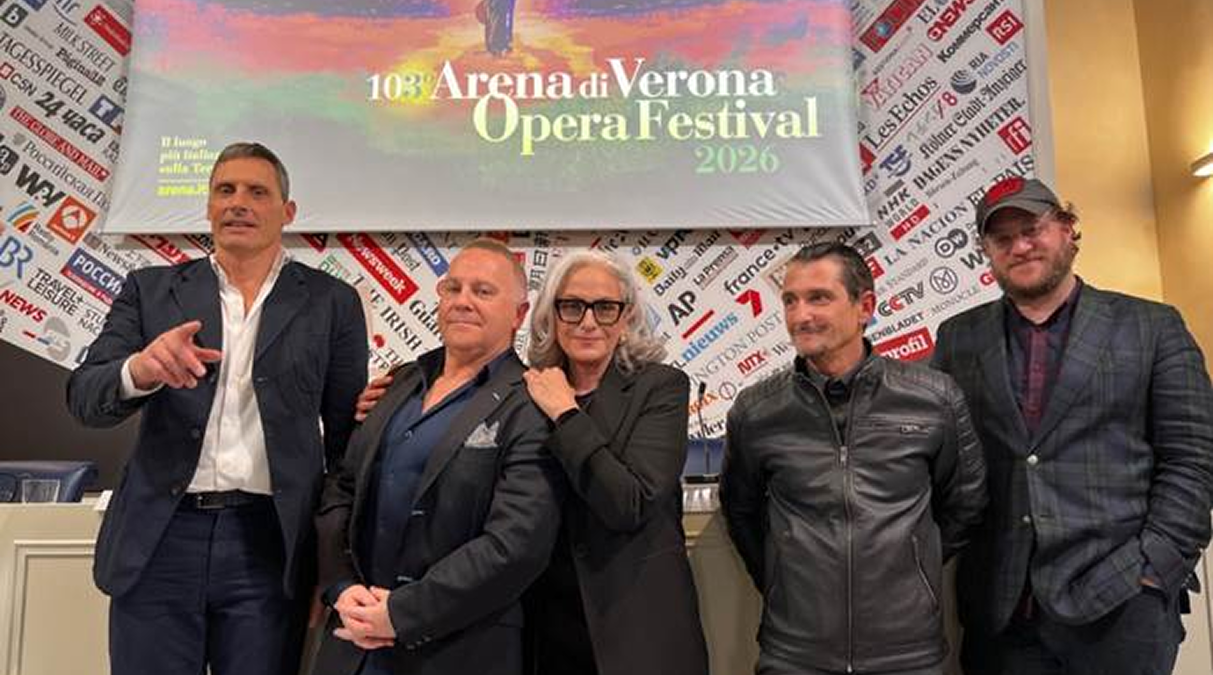
The Arena presents the longest season in its history, spanning more than three months of performances. From 5 June to 12 September, the Opera Festival returns with 53 evenings of performances spanning opera, concerts and dance. Night after night, six opera productions and as many special-event evenings will alternate on stage. A new Traviata, two different stagings of Aida, the most recent productions of Nabucco and La Bohème, and then Turandot on the centenary of its world premiere. And the special event Campioni del Mondo. Italy loves Unesco will be broadcast live to the world on Rai 1, bringing together some of opera's greatest moments, a celebration of Italian cuisine as an intangible cultural world heritage, and the launch of the candidacy of the Neapolitan classical song for inclusion on the Unesco list.
Over three months, the Arena di Verona will have 1,300 people at work across artistic, technical and administrative teams, both inside and outside the theatre, and will host more than 80 conductors and singers: the finest artists on the international scene will alternate on the same stage, returning to the Arena also to make their debuts in new roles: to name only a few, Anna Netrebko, Lisette Oropesa, Rosa Feola, Anna Pirozzi, Maria José Siri, Mariangela Sicilia, Aleksandra Kurzak, Eleonora Buratto, Maria Agresta, Vasilisa Berzhanskaya, Marta Torbidoni, Clémentine Margaine, Annalisa Stroppa, Yusif Eyvazov, René Barbera, Gregory Kunde, Brian Jagde, Roberto Alagna, Amartuvshin Enkhbat, Luca Salsi, Ludovic Tézier, Michele Pertusi, Alexander Vinogradov, Roberto Tagliavini and many others. The season will also see a number of debuts of well-established artists and of some of the best young emerging talents, including Carolina López Moreno, Adam Smith, Mihai Damian, Martina Russomanno, Mariano Buccino, SeokJong Baek, Alexander Roslavets, Ankhbayar Enkhbold, Francesca Pia Vitale, Antonio Poli, Enkeleda Kamani, Carlo Vistoli and others. Alongside the much-acclaimed conductors Michele Spotti, Daniel Oren, Francesco Ivan Ciampa, Andrea Battistoni and Francesco Ommassini, conductors James Conlon, Sebastiano Rolli and Francesco Lanzillotta will make their Arena podium debuts.
LA TRAVIATA. The double opening on 12 and 13 June will feature the new production of Verdi's La Traviata, an opera that made its Arena debut on this very stage in 1946, the first performance of the post-war era. Throughout the summer of 2026, it will be staged for 13 performances until 12 September, the season's closing night. The production will be directed by Scottish director Paul Curran, making his Arena debut with an original and visually striking interpretation that will transport audiences to Paris in the early 1900s, to the nightlife of Montmartre, amid the splendours of the Belle Époque. It was there that the Moulin Rouge, the world's most famous cabaret venue, rose to prominence, and where an unprecedented collaboration with Fondazione Arena now begins. The sets, including for the Moulin Rouge, will be by Juan Guillermo Nova, the costumes by Stefano Ciammitti, the creator of the visionary outfits for the Olympic ceremonies at the Arena, the lighting by Fabio Barettin and the choreographies by Kyle Lang. The new production will remain faithful to Verdi's dramaturgy, setting it against the spectacular, richly contrasting world of the Parisian cabaret, recreated with historical and artistic precision.
It was La Traviata, a subject that captivated Verdi for biographical reasons as well, that marked a decisive turning point in the composer's career and in the world of opera as a whole from its first performance in 1853, a spectacular failure that turned into a triumph the following year and has never since been interrupted. A scandalous story, treated with truth and theatrical force, drawn from The Lady of the Camellias by Alexandre Dumas fils and inspired by the real life of Alphonsine Plessis. Love and sacrifice, private dreams and public judgement collide in what is one of the most frequently performed operas. A contemporary story, for audiences of the time, destined to cause scandal then as now. As director Paul Curran notes, "Violetta's story still feels current. She is judged by the very society that depends on her, admired in public yet deemed unworthy of dignity in private. The Paris of the libretto — Curran continues, outlining the production's features — is brought back to life here on stage, in a 1910s setting. It was a period of extraordinary energy, beauty and liberation. Paris was alive with cabaret culture, music, dance and new artistic ideas. At the same time, behind the glamour, hedonism, spectacle and excess, there were deep social divisions and personal loneliness. This contrast is very close to the emotional world of La Traviata. Our Violetta lives surrounded by pleasure and theatricality. And yet, beneath this world, there is a woman who understands from the outset that her life will be brief. And in the end, despite the spectacle surrounding her, the opera becomes profoundly intimate: it is the story of a young woman in search of love, freedom and dignity in the little time she has left."
MOULIN ROUGE AND THE ELEPHANT. The Arena stage recreates that atmosphere and, thanks to the collaboration with the Moulin Rouge in Paris, marks a new chapter in the history of the Opera Festival. The two great elements that defined the original Moulin Rouge, namely the red mill and the giant elephant, will return to prominence in Parisian nightlife, as they did at the start of the twentieth century. The founders of the Moulin Rouge, Charles Zidler and Joseph Oller, purchased a gigantic plaster elephant they had seen at the Paris Universal Exposition of 1889. They added it to the Moulin Rouge garden as an entertainment space, and it thus became one of the symbols of the era. Until the fateful night of 1913, when everything caught fire and the elephant was destroyed forever. But for the thirteen Arena performances it will return in all its former splendour. The animal recurs repeatedly in French history, from the elephants kept at court by kings to those painted and sculpted between the sixteenth and seventeenth centuries, and on to the plaster Bastille elephant commissioned by Napoleon and immortalised by Victor Hugo in his novel Les Misérables.
CAST. The most beloved and performed show in the world, and the most iconic love story in opera, will star the young Martina Russomanno (12 and 20 June), making her Arena debut. She will then be followed by two sopranos who have already been acclaimed at the Arena for their interpretations of Violetta Valéry – Gilda Fiume (13 and 27 June) and Rosa Feola (from 6 August). Vasilisa Berzhanskaya, who has already cut her teeth with some huge roles from Rossini to Norma, will make her debut as Violetta on 16 and 31 July. Some real darlings of the Arena will be playing the beloved Alfredo: Yusif Eyvazov (for the first time in this role at the Arena), Galeano Salas, Francesco Meli, Enea Scala, René Barbera, and the tenors Antonio Poli and Adam Smith, making their Verona debuts. And the role of Germont's father will then be taken by some world-famous baritones: Amartuvshin Enkhbat, Youngjun Park, Ludovic Tézier, Luca Salsi and the young Mihai Damian, freshly crowned winner of Operalia 2025, making his debut in the Arena. With first-rate supporting roles and the conduction of Michele Spotti and Francesco Ivan Ciampa.
WORKSHOPS. Preparations are in full swing, and Fondazione Arena's workshops are working at full capacity. Carpenters, joiners, electricians, painters, sculptors and decorators are completing the sets and props for the new production piece by piece. Within the 10,000 square metres in Via Gelmetto, the production that will open the Festival is taking shape. From the mill built entirely in wood to the life-size elephant carved in polystyrene, the hands of dozens of artisans are putting the finishing touches to the work. Everything will then be transported to the Arena and assembled directly on stage. The costumes and accessories, meanwhile, are being produced in several workshops in Milan and Rome. As soon as they arrive in Montorio, in the new workshop dedicated to storing and finishing costumes, they will be completed and fitted, artist by artist.
The Festival will continue by bringing back to the stage some of the titles most beloved by the general public.
'Crystal' AIDA. The Queen of the Arena will return in the 'crystal' staging designed by Stefano Poda for the 100th Opera Festival, exceptionally with six performances scheduled between 19 June and 24 July 2026. Welcome to ancient Egypt, where contemporary art and high fashion coexist in a luminous collective ritual. Under the baton of the experienced Daniel Oren, the leading role will be sung by Maria José Siri. Two powerful portrayals of Radames are guaranteed from Yusif Eyvazov and Gregory Kunde, with Amneris brought to life by Judit Kutasi, Alisa Kolosova and Clémentine Margaine, Amonasro by Amartuvshin Enkhbat and Youngjun Park and Ramfis by the basses Alexander Vinogradov and Simon Lim.
NABUCCO. Stefano Poda's 2025 staging of Verdi's opera will return for ten performances, between 26 June and 9 September, conducted by Michele Spotti and Sebastiano Rolli (taking the baton for the first time at the Arena). Verdi's choral humanity portrayed as a war between opposites destined to reunite in a universal whole. Lighting effects ranging from the costumes to the immense stands of the Arena will provide the backdrop to the powerful voices of Amartuvshin Enkhbat (26 June and 4 July), Ludovic Tézier (12 July), Youngjun Park (18 and 23 July and 8 August) and Luca Salsi (1 August and final performances). The challenging role of Abigaille, torn between love and ambition, will be played by Maria José Siri, alternating with Olga Maslova (23 July and 28 August) and Marta Torbidoni (8 and 20 August). Annalisa Stroppa will return to the Arena as Fenena, alongside Anna Werle, while tenors Galeano Salas, Francesco Meli and Paolo Lardizzone will alternate as Ismaele. There will be a parade of great basses in the role of Zaccaria: Roberto Tagliavini on the opening night, then Simon Lim, Alexander Vinogradov and Michele Pertusi.
LA BOHÈME. Verdi will not be the only headliner at the 2026 Festival: 130 years after its world premiere, Puccini's La Bohème will be staged in the production designed by Alfonso Signorini with sets by Juan Guillermo Nova for the 2024 Festival, for four nights from 3 to 25 July. "The perfect opera" that perhaps tells the story of friendship, love and the quintessence of youth better than any other, will feature the acclaimed Eleonora Buratto (3 and 11 July) and Carolina López Moreno (17 and 25 July) as Mimì, opposite Yusif Eyvazov's Rodolfo (with René Barbera alternating in the role on 25 July). The friends Marcello, Colline and Schaunard will be played by Mihai Damian, Alexander Roslavets and Jan Antem. Both the sopranos in the role of the sparkling Musetta will be making their Arena bow: Francesca Pia Vitale and Enkeleda Kamani. Maestro Francesco Lanzillotta is making his debut on the podium of the Fondazione Arena Orchestra.
AIDA (Zeffirelli). The second production of the most performed opera at the Arena Festival since 1913, Verdi's Aida, will return for seven performances in the staging created by Franco Zeffirelli from 30 July to 10 September – a golden Egypt studded with multi-coloured stones and draped in precious fabrics. Under the baton of Francesco Ommassini, for three evenings the title role will be played by Aleksandra Kurzak, accompanied by newcomer SeokJong Baek (30 July) and her partner both on stage and in life, Roberto Alagna (9 and 23 August). For a single exceptional evening, Anna Netrebko will be the Ethiopian princess on 30 August. Maria José Siri will return as Aida for two more performances, as will Yusif Eyvazov and Paolo Lardizzone as Radames, while Clémentine Margaine will be the only Amneris throughout the run, as will Youngjun Park as Amonasro (except for the performance on 30 August, when the role will be sung by Ludovic Tézier). Alongside Alexander Vinogradov and Simon Lim, bass Gianluca Buratto will alternate in the role of the High Priest Ramfis.
TURANDOT. Another Giacomo Puccini title will celebrate exactly 100 years: Turandot, his final masterpiece, completed by Franco Alfano for the first performance, posthumously, in 1926. Turandot will return for six evening performances of Zeffirelli's magical production (a box-office record holder at the Arena) between 7 August and 11 September, featuring costumes designed by Oscar winner Emi Wada. The ice princess will be played by Anna Pirozzi and Lise Lindstrom (21 and 27 August), while hearts will be melted with the portrayals of Calaf by Brian Jagde and Yusif Eyvazov. Mariangela Sicilia (7 August), Lisette Oropesa (making her debut in the role – 14, 21 and 27 August) and Maria Agresta (3 and 11 September) will star as Liù, while Michele Pertusi will perform in the role of Timur. Andrea Battistoni, a maestro from Verona who has enjoyed a fabulous career on three continents, will return to the podium with Francesco Ivan Ciampa.
As always, for all the shows on the bill, just as much care is given to filling the supporting roles. In summer 2026, they will be played by some of the world's most in-demand artists, alongside talented young artists making their debut at the Arena, such as the bass Mariano Buccino, the baritone Ankhbayar Enkhbold and others. The performers include Carlo Bosi, Nicolò Ceriani, Gezim Myshketa, Gabriele Sagona, Francesca Maionchi, Matteo Macchioni, Riccardo Rados, Elisabetta Zizzo, Elena Borin, Clarissa Leonardi, Saverio Fiore, Abramo Rosalen and Gianfranco Montresori.
EVENT EVENINGS. Alongside the eagerly awaited Roberto Bolle and Friends in a one-night-only performance co-produced with ARTEDANZAsrl on 21 July, ballet will also return to the Roman Theatre with the acclaimed production of Zorba the Greek, featuring Lorca Massine's original choreography, on 25 and 26 August. Among the most popular musical programmes in recent seasons, the great symphonic/choral combination deployed in Orff's Carmina Burana will return on 13 August at the heart of the Arena with an exceptional new cast, featuring Erin Morley, Mihai Damian and the countertenor Carlo Vistoli, making his Arena debut, conducted by Maestro James Conlon, also appearing for the first time in the Amphitheatre. Lastly, there will be two exciting innovative event evenings: the new immersive Paganini Paradise concert is making its world premiere on 18 August and joining the Four Seasons in Viva Vivaldi, with the Fondazione Arena Orchestra and spectacular three-dimensional projections created by Balich Wonder Studio, on 19 August.
Ticket offices
Via Dietro Anfiteatro 6/B, 37121 Verona
Via Roma 1, 37121 Verona
biglietteria@arenadiverona.it
Call center (+39) 045 800 51 51
www.arena.it
Vivaticket presale tickets
Information
Fondazione Arena di Verona Press Office
Via Roma 7/D, 37121 Verona – ufficio.stampa@arenadiverona.it
tel. (+39) 045 805.1861-1905-1891-1939-1847
Skill & Music Italian and international press office
Firmina Adorno +39 339 6483224 – firmina.adorno@gmail.com
Paolo Cairoli +39 331 8361276 – paoloalberto.cairoli@gmail.com