Nomisma calculates the economic, social and tourism impact of the Arena di Verona
Every euro invested in the Arena corresponds to 6.3 euros for the Italian economy
Fondazione Arena generates 2 billion euro in induced revenue and 206 million taxes paid to the state, regions and municipalities
Gasdia and Trespidi: “We have shown that it is possible to reverse the aid paradigm”. “The uniqueness of Fondazione Arena should be recognised through a special statute,” according to Fontana and Salvemini. Monti: “The figures call for reflection on the impact of culture, also in view of budgetary manoeuvres”
Fondazione Arena di Verona, through the Opera Festival, generates €2 billion for the Italian economy and €206 million in taxes, while creating almost 6,000 jobs. This multiplier effect has impacts all over Italy: every euro invested in Arena corresponds to 6.3 euro returned to the country.
These are just some of the figures that emerged from a Nomisma study that quantified the economic, employment and fiscal impact of the Opera Festival and the activities of the Fondazione Arena, while also analysing its positioning within the Italian opera/symphony orchestra scene.
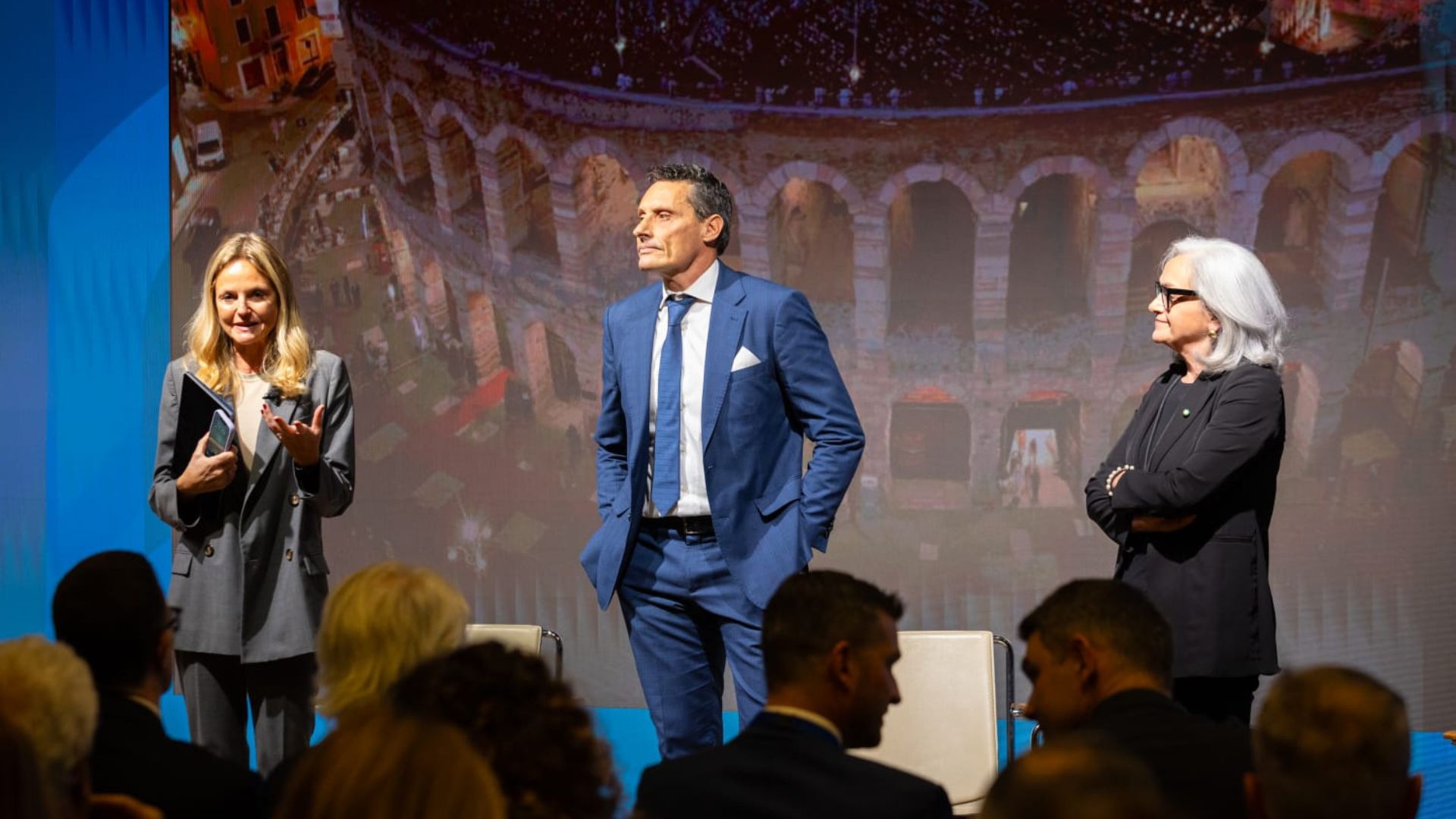
The research was presented this morning in Milan, in the Tower Hall at UniCredit, by the same Nomisma researchers who conducted the survey: Barbara Da Rin, Emanuele Di Faustino and Riccardo Vecchi Lari. Carlo Fontana, President of Impresa Cultura Italia-Confcommercio — formerly General Manager of the Teatro alla Scala 1990-2005, Severino Salvemini, Professor emeritus of Business Organisation at the Bocconi University in Milan and Luciano Monti, Professor of European Union Politics at LUISS Guido Carli in Rome, helped in analysing the data. Various agreements were reached on the next goal to be achieved. “The uniqueness of Fondazione Arena must be recognised through a special statute,” said Fontana and Salvemini. For Monti, “the figures call for reflection on the impact of culture, also in view of budgetary manoeuvres”.
The Undersecretary of Culture, Gianmarco Mazzi, and General Manager of the Fondazione Arena, Cecilia Gasdia, were in attendance, alongside the Deputy Artistic Director, Stefano Trespidi, and the President of Nomisma, Paolo De Castro. UniCredit were represented by Francesco Mario Iannella, Head of the North East Region, and Stefano Gallo, Head of Territorial Development. Lastly, the President of Fondazione Cariverona, Bruno Giordano, was also a guest. The event was moderated by the journalist, Sarah Varetto.
The survey highlights the uniqueness of Fondazione Arena with respect to the Italian opera/symphony scene: 71% of the value of the production comes from ticket sales, sponsorships and private contributions. Only 29% comes from public contributions, unlike other foundations with ordinary statutes, whose situation is practically the opposite, with an average of 25% of own resources and 75% of public contributions.
It is estimated that the 404,715 spectators of the Arena Opera Festival in the 2025 opera season spent a total of €315 million on food, accommodation, shopping, recreational and cultural activities and transport. The value of the production generated in Italy by the Arena Opera Festival, thanks to the spending of the spectators during the 2025 opera season was therefore equal to a total of €1,976 million euro (direct, indirect and induced impact). Approximately 60% remains within the Province of Verona — as much as 1 billion, 127 million euro. 20% (or €392m) is concentrated in other Provinces of the Veneto Region and a further 22% (or €447m) is produced in other areas of Italy. The tax effect induced by the tourism spending of spectators amounts to a total of approximately €206m: of these, 87% (or €179m) is collected by the State, 9% by the Regions (€18m) and the remaining 4% by the Municipalities (around €9m). It is estimated that about €4m (or 1.9% of the total) are collected by the Municipality of Verona as tourist tax and direct and indirect taxes, and that €14.1m (or 7% of the total) go to the Veneto Region.
The research will also be presented at the Teatro Filarmonico in Verona, at 5.45 p.m. on Tuesday 18 November, during the event ‘Culture as a value’, organised with the Athesis Group. The free event, open to all, will see the main local stakeholders discuss the results of the study to define the role, challenges and responsibility of culture as a driver of the economy.
Gianmarco Mazzi, Undersecretary of State for Culture: “In 2022, when I was appointed Undersecretary of State for Culture, I set myself two objectives for Italian opera: the renewal of the national collective agreement, which has been in place for twenty years, and UNESCO recognition of Italian opera singing. In just a few years, we have managed to achieve both these goals. The art of opera singing was celebrated with a huge party in the Arena. A repeat in 2026 would be fantastic. This is because the Arena is the symbol of opera around the world and the Fondazione Arena is a cultural enterprise, which, when we look at the figures, generates results that benefit the whole country. And all this is achieved with the use of public resources, which are perceived not as a form of state aid but rather as a genuine investment that can serve as a catalyst for private resources".
Cecilia Gasdia, General Manager of Fondazione Arena: “Over a hundred years of history have created an extraordinary phenomenon and an immense wealth of skills. Fondazione Arena is the only Italian opera/symphony institution that originated from a Festival. And from the private initiative of one of the greatest tenors in history: Giovanni Zenatello, who invested almost all his fortune in his city and in the Arena. Through many years of work, we have striven to create a business. The results presented today show that investing in culture generates wealth for the whole country."
Alessia Rotta, Councillor for the Municipality of Verona: “The Arena as a symbol of Verona? That’s set in stone, literally. And it is the Fondazione Arena that brings it to life today, making its identity a reflection of the entire city. This rigorous research underlines the importance of what is a real economic and artistic driver, capable of creating induced revenue for the entire community since, as the survey shows, 60 per cent of the value remains in Province of Verona. This Nomisma study testifies to the strength and power of our cultural institution and the importance of public and private support."
Stefano Trespidi, Deputy Artistic Director of the Fondazione Arena di Verona: "The Fondazione Arena is an extraordinary machine from an artistic and cultural point of view, a beacon and bulwark of ‘made in Italy’ quality all over the world. It was with this in mind that we have sought to find a way to represent its value in a scientific way. It is time to make a radical change in the relationship with all stakeholders. It is time to overturn the paradigm that normally governs relations between cultural operators and institutions, private supporters and suppliers — a paradigm that has always been based on the concept of aid. Bolstered by our awareness of the role we play and today’s results, we can proudly proclaim: support us because we generate work, wealth and values".
Francesco Iannella, North East Regional Manager at UniCredit: “We are proud to have hosted the Fondazione Arena event in our Milan headquarters, sealing a more-than-thirty-year partnership based on shared values, projects and objectives. UniCredit considers culture a driver for social and economic development, fully in keeping with our mission of Empowering Communities to Progress. Collaboration with the Fondazione Arena di Verona is seen as a union between two institutions with an international vocation, aimed at enhancing Italian artistic heritage and making it accessible to an ever wider audience".
STUDIO NOMISMA
SURVEY SAMPLE AND METHODOLOGY
In May 2025, a survey was conducted on the Italian population involving 1,200 individuals aged between 18 and 65. Between June and July 2025, a survey was also conducted on a representative sample of spectators (both foreign and Italian) at the Arena Opera Festival. In addition to the surveys on the population and spectators, between June and July 2025 Nomisma also started a phase of listening to companies in the Verona area operating in the hospitality sector (accommodation and restaurants) and in the commercial sector. In order to quantify the impacts on the economy and jobs, the tourist expenditure linked to the spectators of the 2025 season was estimated by analysing data from national public statistical sources, trade associations and the qualitative/quantitative analysis conducted by Nomisma on a representative sample of spectators. Once the key figures in the sector and market had been reconstructed, it was possible to assess the economic impact of the Arena Opera Festival for the 2025 season, developed in collaboration with ELL — Economics Living Lab, a spin-off company of the University of Verona, using social accounting matrices (SAM).
ATTRACTIVENESS OF THE CITY AND IMPORTANCE OF THE FOUNDATION
The Arena Opera Festival: cultural and international excellence
The Arena Opera Festival is one of the greatest expressions of Italian musical culture and is recognised as the most important open-air opera festival in the world. In 2025, it welcomed over 404,000 spectators to 48 shows, generating total revenue of more than €35 million. Of these visitors, 61% came from abroad, which clearly demonstrates the Festival's strong international vocation. Indeed, opera-goers at the Arena Opera Festival represent 20% of all spectators.
The importance of the Festival is also reflected at national level: six of the top ten shows in terms of number of spectators and seven of the top ten in terms of revenue in Italy were performed during the Arena season. This cultural and artistic significance translates into a significant impact on the city: 61% of the Italian population and 60% of the population of Verona consider the Arena Opera Festival one of the main events for the promotion of Verona, helping to increase its tourism, economic and cultural visibility. This positive perception is even more marked among entrepreneurs (67%) and spectators (80%), who recognise the Festival as a distinctive element of Veronese identity.
The Festival is considered an element of the city’s identity by 89% of the population and by a similar share of companies. It plays a vital role in terms of education and culture, promoting musical training and the dissemination of culture, an effect recognised by 87% of the population and 76% of businesses. It also contributes to increasing a sense of belonging to the city and social cohesion for 78% of citizens and to improving the quality of city life for 67% of the population. Overall, the Arena Opera Festival emerges as a collective asset and a driver of cultural and civic development, capable of generating not only economic value but also identity for the entire Veronese community.
RESOURCE AND CONTRIBUTION BENCHMARK: THE FAV MODEL
Economic autonomy and the ability to generate own resources
The Fondazione Arena di Verona stands out from the average foundation with an ordinary statute for its ability to generate its own resources, both with respect to the 11 Symphonic Opera Foundations with Ordinary Statutes, and to those with Special Statutes, through sponsorships and ticket sales. In 2024, in fact, 56% of the value of the production of the Fondazione Arena di Verona (FAV) came from sales revenues, a share markedly higher than the average of the other Foundations: 35% for Special Statute Foundations, 19% for those with Ordinary Statutes and 18% for the foundations in nearby cities such as Bologna, Florence and Venice.
Analysis of the ability to generate value through own resources and public sources shows the weight of public contributions for the Fondazione Arena Verona amounts to 29%, a much lower share than the 38% of Foundations with Special Statutes and, in particular, the other two benchmarks represented by the 11 Foundations with Ordinary Statutes and those geographically close to Verona (75% of total revenues).
It follows that the Fondazione Arena di Verona stands out positively for its ability to generate not only cultural and social value, but also economic value, thanks to its own resources such as ticket revenues, sponsorships and private contributions. The amount of these resources, more than 71% of total revenue, is almost triple the average of Italian Opera/Symphony Foundations.
Public support and private patronage
Public contribution represents an important financing instrument for the Fondazione Arena di Verona, albeit with a lower impact on the overall capacity to generate value than the other benchmark Foundations under analysis. In particular, in addition to the important endowment provided by the State within the FNSV, we would like to highlight the contribution of the Municipality of Verona, which, in addition to the portion paid as a grant, supports the activities of Fondazione Arena di Verona by making offices and ticket offices, spaces used as warehouses and theatres themselves available free of charge (pursuant to Art. 23 of Italia Law 800/67). The analysis also shows that the Veneto Region is ranked last in the classification of regional contributions to Symphony/Opera Foundations, with €680,000 paid to FAV in 2024 (1.1% of the value of production), while regions such as Sicily and Sardinia allocated over €8 million to their respective Foundations in the same year.
On the private contribution front, the Fondazione Arena di Verona concluded its eleventh year of fundraising through Art Bonus in 2024, reaching almost €29 million during the period. Some of the main initiatives include ‘67 columns for the Arena di Verona’, launched in 2021 together with Gianluca Rana, CEO of Pastificio Rana, and Sandro Veronesi, Founder and President of Oniverse, which has raised over €9 million in 5 years, confirming the crucial role of private patronage in supporting the activities of the Foundation.
ANALYSIS OF IMPACTS ON THE ECONOMY AND JOBS
The impact on the economy and jobs
It is estimated that the 404,715 spectators of the Arena Opera Festival in the 2025 opera season spent a total of €315 million on food, accommodation, shopping, recreational and cultural activities and transport.
The value of the production generated in Italy by the Arena Opera Festival, thanks to the spending of the spectators during the 2025 opera season was equal to a total of €1,976 million euro (direct, indirect and induced impact).
Of these, €519 million are attributable to the direct effect, i.e. the production intended to satisfy the tourist expenditure of the spectators at the Arena Opera Festival, or rather the expenses related to food, accommodation, shopping, recreational and cultural activities and transport. The indirect effect, i.e. the effect produced by suppliers and sub-suppliers of companies active in the tourism sector (accommodation and catering; retail; creative, artistic and entertainment activities; transport) amounts to €324 million. These include, for example, supplies of food and other goods, utilities and rents, services for businesses (e.g. logistics and transport, consultancy). The induced effect, which is attributable to the re-entry of labour and capital income into the economic system and the re-investment of tax revenues in the form of public expenditure, amounts to €1,132 million.
Considering the set of three effects, the final multiplier stands at 6.3: this means that every euro spent by the spectators of the Arena Opera Festival generates (in direct, indirect and induced terms) 6.3 euro of production value for the national economy.
In terms of employment, the effect is also significant: there are 5,635 full-time employees active across Italy thanks to the expenditure of the spectators of the Arena Opera Festival.
The impact at local level
About 60% of the value produced remains within the Province of Verona, confirming the strong link the Arena Opera Festival has with local producers; specifically, of the €1,976-million value of the production generated, it is estimated that €651 million (equal to 33% of the total) will be created within the borders of the Municipality of Verona, while the remaining €486 million (i.e. 25%) will be produced in other parts of the Province. Lastly, a further 20% of the value of production (€392m) is concentrated in other Provinces of the Veneto Region and a further 22% (or €447m) is produced in other areas of Italy.
The economic sectors influenced by the Arena Opera Festival
Through its activities and the spending of the spectators who attend its events, the Arena Opera Festival involves multiple economic sectors.
In total terms (i.e. considering the direct, indirect and induced impacts), the sectors that benefit most from the presence of the Arena Opera Festival, and therefore from the spending by spectators during its events, are firstly the retail and wholesale sectors — which take 15.3% of the value of the production created — accommodation and catering — with a weight of 15.1% — and personal services (such as health, institutional, cultural and entertainment activities), with a weight of 14%. Other sectors which benefit, in direct, indirect and induced terms, from the spending of the spectators of the 2025 opera season are transport and storage (9.2%), property and agri-food activities (both with a weight of 8.7%).
With regard to the property sector, this is mainly an induced effect linked to the spending of families receiving income through in the sale or rental of homes, while with reference to the agri-food sector, there is both an induced (household consumption) and indirect effect, i.e. linked to the supplies and sub-supplies of companies in the hospitality sector.
The view of the community
Local citizens and companies also recognise the contribution of the Arena Opera Festival to the city's economy. According to the survey conducted by Nomisma, 83% of companies and 88% of the population believe that the shows organised as part of the Arena Opera Festival help make the city of Verona more attractive. At the same time, this also generates employment and creates wealth in different sectors in the Verona area. Almost all companies (89%) and the entire population (88%) agree.
As further confirmation of its importance for the territory, the Arena Opera Festival were to cease, the (negative) effects would be significant according to both the population and the companies. The greatest impacts would be in terms of reducing the international visibility of Verona, significant economic loss for the tourism sector, falling numbers of visitors and tourists in the city and negative effects on the local cultural and artistic sector, together with a change to the cultural identity of the city.
FISCAL IMPACT OF FAV AND THE ARENA OPERA FESTIVAL
The cultural activities promoted by the Fondazione Arena, thanks primarily to the Arena Opera Festival, generate substantial tax revenue, which is distributed to the State and local authorities both locally (Veneto Region and Municipality of Verona) and in other areas of the country. To assess the magnitude of this effect, the analysis focused on two dimensions: contributions and taxes paid by the Fondazione Arena di Verona and other taxes attributable to the Arena Opera Festival.
Taxes and contributions directly linked to the activities of Fondazione Arena di Verona
In 2024, the Fondazione Arena’s budget contribution for direct and indirect taxes amounted to over one million euro. The effect is greatly amplified if we consider the VAT on FAV supplies, which is close to €4.5 million, in addition to the taxes that Fondazione Arena pays on behalf of its workers, employees and self-employed agents, which represent an additional €5 million. These substantial amounts of tax are, in fact, linked to the activities of FAV and its workers, with tax payments or debts that would not exist without the Fondazione Arena. However, the existing employment relationships for FAV also generate a significant amount of contributions, with INPS shares and INAIL premiums exceeding €8 million per year.
The tourism presence of spectators and the effects on the tourist tax
While the Arena di Verona is the main tourism and cultural attraction in the city, the Arena Opera Festival is able to further enhance the attractiveness of Verona during the summer months. This translates into consumption for goods and services, which generate different dynamics in tax matters, the most significant of which is the effect linked to the tourist presence of the spectators. Spectators' access to hotel facilities contributes to the collection of approximately €1.2 million, or more than 15% of Verona's annual tourist tax collection, with the share estimated to exceed 40% in the summer months alone.
The indirect and induced tax impact attributable to the Arena Opera Festival
In addition to the taxes and duties paid directly by the Fondazione Arena di Verona for ordinary management, as well as the contribution to the tourist tax, the tourism spending of the spectators of the Arena Opera Festival contributes to the generation of production and consumption in multiple economic sectors and, therefore, to the collection of further taxes from citizens and businesses.
Specifically, the tax effect induced by the tourism spending of spectators amounts to a total of approximately €206m: of these, 87% (or €179m) is collected by the State, 9% by the Regions (€18m) and the remaining 4% by the Municipalities (around €9m). It is estimated that about €4m (or 1.9% of the total) are collected by the Municipality of Verona as tourist tax and direct and indirect taxes, and that €14.1m (or 7% of the total) go to the Veneto Region.