Falstaff, Verdi’s final masterpiece on stage at the Teatro Filarmonico
Sunday, March 22: the premiere of Jacopo Spirei’s brilliant and pop production. The Orchestra and Chorus of Fondazione Arena are conducted by Giuseppe Grazioli.
The lyric comedy based on Shakespeare returns to Verona after 15 years. Four performances from March 22 to 29
Saturday, March 21 at 6 PM, for the Music and Cinema series, Shakespeare in Love, the 7-time Oscar-winning film at the Teatro Filarmonico
Thursday, March 19 at 6 PM, in the Sala Veranda of the Accademia Filarmonica, the opera will be presented to the public in a free encounter with writer and critic Giovanni Gavazzeni

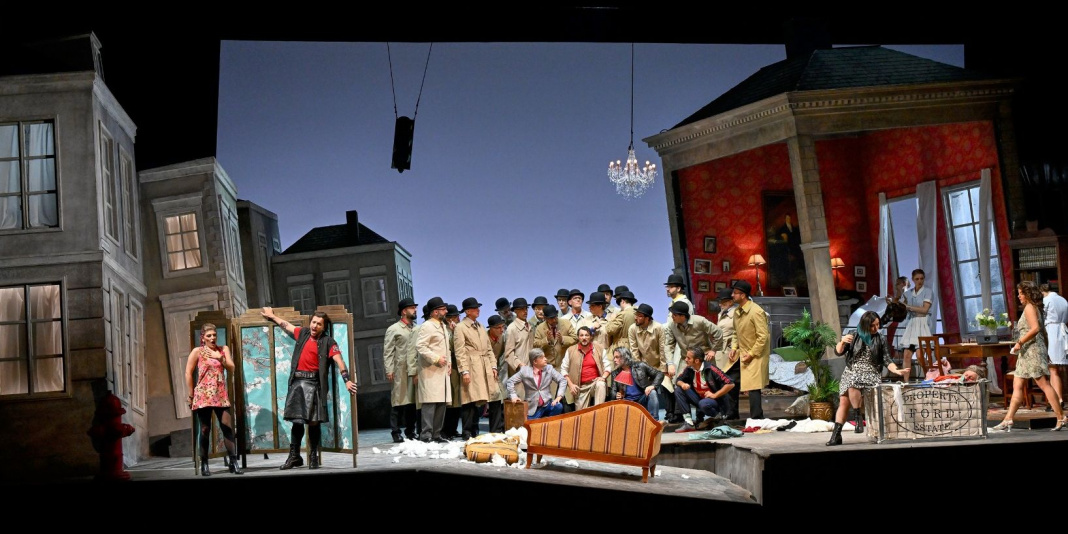
Presentation of Falstaff at the press conference in Sala Fagiuoli: from left, Verona City Councilor Pietro Trincanato, Assistant Artistic Director of Fondazione Arena di Verona Stefano Trespidi, conductor Giuseppe Grazioli, director Jacopo Spirei, and Chorus Master Roberto Gabbiani. Below, two shots from the premiere of Falstaff in Parma ©Roberto Ricci/Teatro Regio di Parma.
Verdi, the great father of Italian melodrama, closed his career at age 80 with a smile: in the hilarious lyric comedy Falstaff, Boito's verses and the music of a more brilliant Verdi than ever bring to life the legendary character created by Shakespeare with the merry wives of Windsor. Among the most refined titles in the repertoire, the opera returns to the Teatro Filarmonico in Verona after fifteen years on Sunday, March 22 at 3:30 PM in the dynamic and “British” production from the Regio di Parma directed by Jacopo Spirei. Ten artists compose the cast tackling the linguistic and vocal virtuosity of Falstaff, led by buffo baritone Marco Filippo Romano, debuting in the role. The Arena's artistic and technical ensembles are led by maestro Giuseppe Grazioli. After the premiere, performances on March 25, 27, 29.
After a career studded with successes, at the age of 80, Giuseppe Verdi (1813-1901) surprised the world with a comedy: a wise smile, at times melancholy, but always brilliant, sealing an eternal youth. The year was 1893 and at La Scala, just a week after the Turin premiere of Manon Lescaut by the rising star Puccini, the audience discovered Falstaff, a lyric comedy that stages William Shakespeare's The Merry Wives of Windsor. An inexhaustible source of melodies, pure musical theater with a multicolored orchestra and frantic pace, unforgettable lines and parodies (even of Verdi himself), the opera utilized the scholarly and varied libretto by Arrigo Boito (1842-1918) who, beyond the plot (a “spin-off” dedicated to the legendary Falstaff at the request, it seems, of Queen Elizabeth herself) reconstructs the greatness of the protagonist from several passages of Henry IV, a historical drama in two parts where Falstaff, with all his eccentricity and very human flaws, is the comic mentor to the future King of England.
Verdi united in this work his love for Shakespearian dramaturgy and characters, the experience of a lifetime as a man of the theater, the refinement of a man of letters such as Boito (already the librettist for the acclaimed Otello) and personal revenge for his only opera buffa, the early Un giorno di regno, which was an absolute failure in 1840. Starting from a “buffa fugue,” Verdi ironically bent centuries of musical forms and traditions, with the final certainty that “he laughs best who has the final laugh,” that “everything in the world is a jest” and that all men are “fooled.” The result was Falstaff, a highly original comedy, livelier than any other, an inspiration for many future composers of musical comedy and “conversation” theater. A pioneering opera for the Italian musical scene of 1893, whose initial success was more of esteem than convinced understanding, but which won over the public over time, thanks to legendary performers such as Stabile, Valdengo, Gobbi, Taddei, Bruson, Raimondi and, more recently, Maestri, and thanks to the greatest conductors ever, including the dedication of Toscanini, Karajan, Giulini, Bernstein, Solti, Abbado and Muti. In Verona, over the last fifty years of the Teatro Filarmonico’s activity with the artistic and technical ensembles of Fondazione Arena, Falstaff has been staged four times (1983, 1997, 2004 and 2011), comparing itself more than elsewhere with Salieri's namesake opera (from a century earlier) to which the rebirth of the Theater itself is linked. In the prestigious casts that have alternated in the Scaliger city, it is worth noting the leading roles of Renato Bruson and Michele Pertusi, also immortalized in exemplary recordings, as well as the debut as opera director of Luca Guadagnino.
In the tradition of the best Italian vocal school is the return of Falstaff to the Teatro Filarmonico, fifteen years after the last production: the title role will be held by Marco Filippo Romano, making his debut in the role of Falstaff. The merry wives of Windsor include sopranos Marta Mari as Alice Ford, Vittoriana De Amicis as Nannetta her daughter, Marianna Mappa as Meg Page and mezzo-soprano Anna Maria Chiuri as Mrs Quickly. In the shoes of Ford, a jealous husband victim of both the protagonist and Alice's cunning, baritone Luca Micheletti, recently conducted by Riccardo Muti as Macbeth, another Verdi-Shakespeare protagonist, while as Fenton, in love with Nannetta, tenor Marco Ciaponi returns. Completing the cast: Blagoj Nacoski as Dr. Caius, Matteo Macchioni and Mariano Buccino as Falstaff’s followers, Bardolfo and Pistola. Maestro Giuseppe Grazioli returns to the Veronese podium to lead the soloists, the Orchestra of Fondazione Arena and the Chorus prepared by Roberto Gabbiani. The production staged in Verona comes from the Teatro Regio di Parma, where it was applauded in 2017 and 2025 at the Verdi Festival, and combines the verve of the original dramaturgy with a British touch and contemporary pop for a rhythm always in step with Verdi's brilliant gift of music: the director is the award-winning Jacopo Spirei, in his first direction at the Teatro Filarmonico, with sets by Nikoalus Webern, costumes by Silvia Aymonino and lighting by Fiammetta Baldiserri.
After the premiere on Sunday, March 22, Falstaff repeats on Wednesday 25 at 7 PM, Friday 27 at 8 PM and Sunday, March 29 at 3:30 PM.
The 2026 Opera and Ballet Season includes three other opera titles and two ballets, with absolute premieres for Verona: it is still possible to purchase subscriptions, new carnet and individual tickets for every date at the link www.arena.it/it/teatro-filarmonico, at the Arena Box Offices and in the Vivaticket network.
BCC Veneta confirms itself as the main sponsor of the 2026 Artistic Season of the Teatro Filarmonico.

IN-DEPTH ENCOUNTER OPEN TO THE PUBLIC
Throughout the 2026 Opera and Ballet Season, free in-depth encounters are confirmed, in collaboration with the Accademia Filarmonica di Verona, on the Thursdays preceding the premieres. Falstaff will be presented to the public on Thursday, March 19 at 6 PM in the prestigious Sala Veranda of the Accademia Filarmonica (via Mutilati 4) by journalist, critic and writer Giovanni Gavazzeni. Free admission while seats last.
MUSIC AND CINEMA: SHAKESPEARE IN LOVE
On Saturday, March 21, at 6 PM, the Teatro Filarmonico transforms into a movie theater: for the 2026 series, Music and Cinema, on the Saturday preceding the Opera and Ballet premieres, Fondazione Arena di Verona screens exceptional cult films in their original language inspired by the subjects on stage. Falstaff, among the most emblematic characters of all the creation of the English Bard, offers the inspiration for Shakespeare in Love. The 1998 film, directed by John Madden, narrates the love of the writer William Shakespeare for a noblewoman, Lady Viola, born during the preparation of Romeo and Juliet. Shakespeare in Love was awarded 3 BAFTAs, 3 Golden Globes and a total of 7 Oscars out of 13 nominations, including best picture, best costumes, best original score and best screenplay (by Tom Stoppard and Marc Norman). Stellar cast: Joseph Fiennes, Gwyneth Paltrow, Judi Dench (both Oscar winners for this film), Geoffrey Rush, Rupert Everett, Colin Firth, Ben Affleck. Tickets at 5 euros on sale online and at the Box Offices in via Dietro Anfiteatro and via Roma.
EVENTS FOR YOUTH AND STUDENTS
With Falstaff, the 2026 programming of Arena Young continues: shows, encounters and initiatives for children, students, families, staff of schools, universities, academies. The opera debuts in fact with the Preview reserved for students and youth, already sold-out for Friday, March 20 at 4 PM, preceded by a dedicated presentation. For the series Andiamo a teatro (Let's go to the theater), the school world will be able to attend the midweek performances at the Filarmonico by participating in the Prelude one hour before the show: an introduction to the plot, characters and language of musical theater, curated by Fondazione Arena, in the prestigious Sala Maffeiana, on Wednesday, March 25 at 6 PM and Friday, March 27 at 7 PM. Information and reservations: Education Culture and Training Office scuola@arenadiverona.it – tel. 045 8051933
THE PLOT IN BRIEF
The fallen noble Sir John Falstaff, dedicated to life's pleasures but without a penny left, tries his luck with the intention of seducing (and robbing) two wealthy married ladies of Windsor. He does not know, however, that Alice Ford and Meg Page are friends: with their brilliant neighbor Quickly and Nannetta, Alice's daughter, the women discover the scam of the identical love letters and hatch a joke at Falstaff's expense, pretending to yield to his advances. Meanwhile, Bardolfo and Pistola, repentant henchmen of Sir John, reveal his plans to Mr. Ford, with the help of young Fenton and Dr. Caius (both suitors of Nannetta). Ford introduces himself to Falstaff under a false identity to test him, unaware of the plan already put in place by the merry wives: discovering the appointment behind his back, he will feel betrayed and return furious to the house with the whole neighborhood. It is only the first of Falstaff's misfortunes, who will be the protagonist of a grand finale in a truly “magical” night in the Windsor woods.
ARENA DI VERONA BOX OFFICES
Via Dietro Anfiteatro 6/b
Open Monday to Friday (10:30 - 16:00)
Saturday (09:15 - 12:45)
closed on Sunday
Via Roma 1
Open Tuesday, Thursday and Saturday (10:00 - 18:00)
Wednesday and Friday (13:00 - 20:00)
Sunday (12:00 - 15:30)
closed on Monday
biglietteria@arenadiverona.it
Call center (+39) 045 8005151
www.arena.it
Vivaticket sales network
INFORMATION
Press Office Fondazione Arena di Verona
Via Roma 7/D, 37121 Verona
tel. (+39) 045 805.1861-1905-1891-1939
ufficio.stampa@arenadiverona.it – www.arena.it