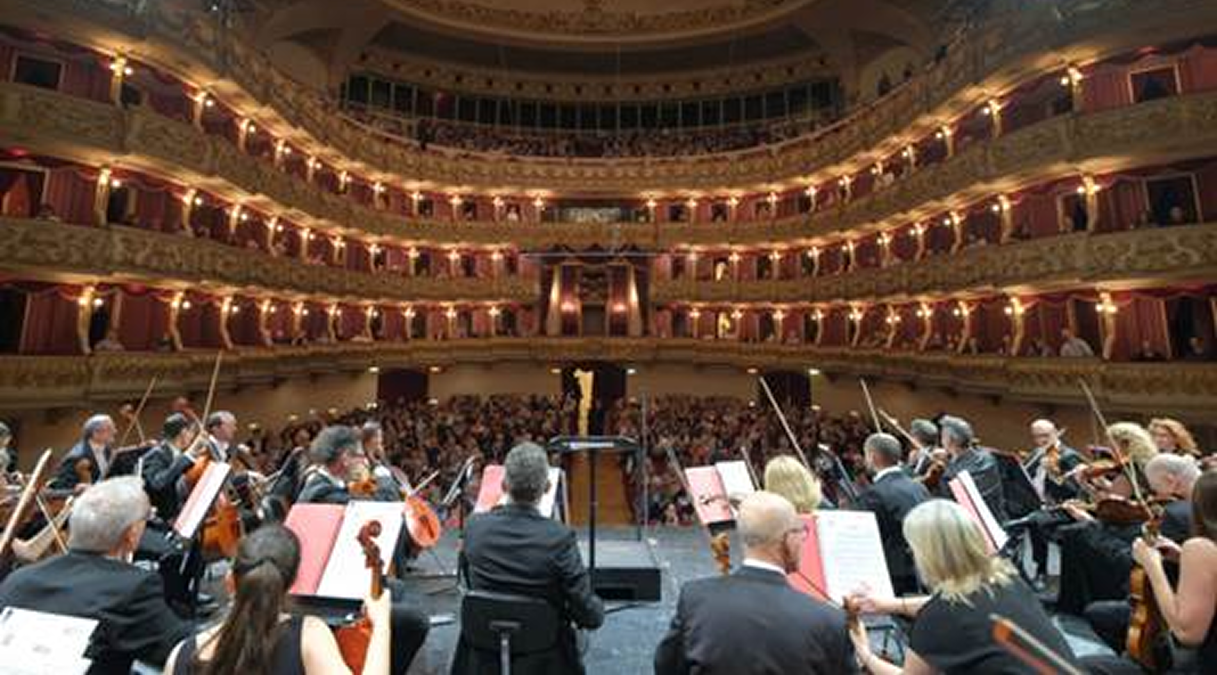
A journey through symphonic Romanticism with Caetani and Yang at the Filarmonico
On Friday 10th and Sunday 12th April, the Fondazione Arena Orchestra tackles two great classics of the repertoire: Mendelssohn’s Violin Concerto and Berlioz’s Symphonie Fantastique. Two faces of the same era, vastly different yet equally seductive. Two of today’s most sought-after performers make their debut at the Teatro Filarmonico: the renowned conductor Oleg Caetani and the award-winning violinist Inmo Yang.
Berlioz FANTASTIQUE
Caetani, Yang
Friday, April 10 8:00 PM
Sunday, April 12 5:00 PM
Teatro Filarmonico, Verona
Symphonic Season 2026 returns to the Teatro Filarmonico: on Friday, April 10 at 8 PM and Sunday, April 12 at 5 PM, the Fondazione Arena Orchestra will be conducted by Oleg Caetani, one of today's most sought-after masters, in Berlioz's Symphonie fantastique, a passionate journey from dream to nightmare that revolutionized Romantic music. Opening the program is Mendelssohn's Violin Concerto, an absolute masterpiece of the genre, featuring soloist Inmo Yang, the thirty-year-old winner of the Paganini and Sibelius prizes. Two great artists of today, both making their debut with Fondazione Arena. An unmissable double appointment, with a prelude open to schools on Friday, one hour before the concert.
Melancholy and joy, dream and delirium, ecstasy and passion: strong and opposing emotions coexist in the second symphonic appointment of 2026 by Fondazione Arena di Verona at the Teatro Filarmonico. German composer Felix Mendelssohn-Bartholdy on one side and Frenchman Hector Berlioz on the other. Nearly contemporaries and both exquisite orchestrators, they animated the European musical scene between the 1830s and 1840s, revolutionizing it in opposite but equally significant ways regarding form and the revival of past authors.
Mendelssohn, born in Hamburg but moved to Leipzig where he was an acclaimed performer of Bach and Handel rediscoveries, was a former child prodigy who lived only 38 years but wrote hundreds of orchestral, sacred, theatrical, and chamber works of excellent craftsmanship. Some are undisputed masterpieces, such as the symphonies, oratorios, overtures, incidental music for A Midsummer Night's Dream, and of course the Violin Concerto in E minor op. 64. Written in 1844, it is among his last and most successful works: an ever-present melodic vein stands in perfect balance between Romantic lyricism and virtuosity. A necessary test for every violinist, like the young Inmo Yang, trained in Korea, the United States, and Germany, and winner of some of the most important international competitions, such as the Paganini in Genoa (2015) and the Sibelius in Helsinki (2022). He will debut with the Fondazione Arena Orchestra alongside the celebrated conductor Oleg Caetani, among the most requested and eclectic masters of our time, who previously conducted the first complete symphonic cycle of Shostakovich in Italy. Within a multi-year journey of reinterpreting Mendelssohn by the Arena's artistic ensembles, the Violin Concerto returns after ten years, following illustrious predecessors such as Accardo, Krylov, Ricci, Ughi, and Zanon.
The variety of orchestral atmospheres and colors reaches its climax in the second part of the concert with the Symphonie fantastique, which Berlioz wrote in 1830 with an autobiographical fantasy program narrating events and emotions through an "idée fixe" that returns in every movement: a musical depiction of the beloved woman, an obsession from the first fatal encounter to a wild ball with a waltz, a bucolic country scene, and finally a hallucinated night at a witches' sabbath. The (hyper)romantic inspiration was Berlioz's tormented love for the actress Harriet Smithson, who later became his wife, unlike the symphony's final nightmare, dictated by opium as it was for many maudit authors of the French 19th century. Certainly, the contents of the symphony and its five-movement structure contributed to creating, after the initial outcry, a new path for French authors and, internationally, for all symphonic program music. A totalizing experience even for today's audience, called to follow peaks and abysses in ever-surprising landscapes of the soul.
The 2026 Symphonic Season offers six other double-date appointments between April, May, and November, featuring in-demand international conductors and soloists tackling great classics from the 19th century to the present, several Verona premieres, and world premieres commissioned by Fondazione Arena: it is still possible to purchase subscriptions, new carnets, and single tickets for each date at the link https://www.arena.it/it/teatro-filarmonico, at the Arena Box Offices, and through the Vivaticket network.
BCC Veneta renews its bond with Fondazione Arena di Verona for 2026, confirming its role as main sponsor of the Artistic Season at the Teatro Filarmonico.
EVENTS FOR YOUTH AND STUDENTS
The Arena Young 2026 programming also covers the entire Symphonic Season. Every Friday, for the Andiamo a teatro (Let's go to the theatre) series, the school world can attend concerts at discounted rates, participating in the Prelude one hour before the performance: an introduction to the plot, characters, and language of musical theatre, curated by Fondazione Arena. Information and reservations: Education, Culture, and Training Office scuola@arenadiverona.it – tel. 0458051933
ARENA DI VERONA BOX OFFICES
Via Dietro Anfiteatro 6/b
Open Monday to Friday (10:30 AM - 4:00 PM)
Saturday (9:15 AM - 12:45 PM)
Closed on Sunday
Via Roma 1
Open Tuesday, Thursday, and Saturday (10:00 AM - 6:00 PM)
Wednesday and Friday (1:00 PM - 8:00 PM)
Sunday (12:00 PM - 3:30 PM)
Closed on Monday biglietteria@arenadiverona.it
Call center (+39) 045 8005151 www.arena.it
Vivaticket sales network