Turandot
Accessible opera bookletGiacomo Puccini
Turandot
by Giacomo Puccini
Opera in three acts and five scenes.
Libretto by
Giuseppe Adami and Renato Simoni
This is the accessible program booklet for Turandot by Giacomo Puccini.
It provides audio versions of the texts, audio descriptions for the images and videos in International Sign Language (ISL).
The texts can be easily zoomed in and out, and the contrast of the display can be increased.
The “Audio Text” button plays the audio of the texts read by a male voice while the “Audio Description” button plays the audio descriptions of the pictures read by a female voice.
The “ISL” button plays videos with International Sign Language.
By using this accessible program booklet, you give explicit consent to accessing content hosted on third party websites.
Synopsis
Act I
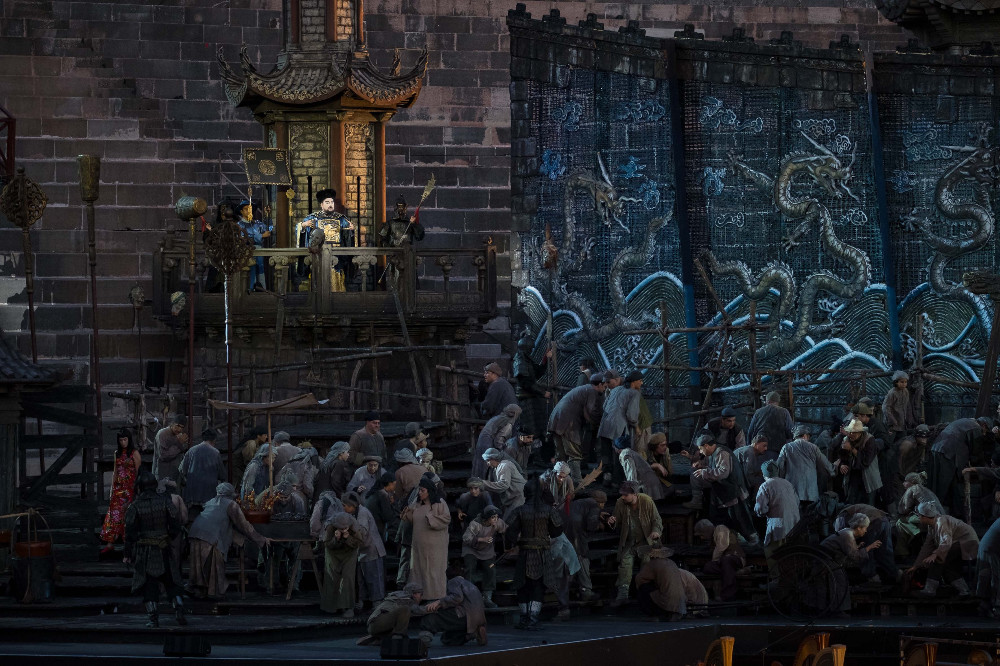
A Mandarin man in Peking relays Princess Turandot's decree to the people: any prince seeking to marry her must solve three riddles, or face beheading (as witnessed with the latest failed suitor from Persia). While the crowd awaits the next trial, Calàf (an exiled prince in disguise) reunites with his blind father Timur, accompanied by the loyal slave girl Liù. However, when he sees Turandot, he falls in love with her at first sight and decides to try his luck in turn. The three imperial ministers (Ping, Pang, and Pong) try to dissuade him, while Liù (who has always loved him) begs him not to risk his life. But their pleas are futile. After asking Liù to take care of the elderly Timur, Calàfbravely steps forward to face the perilous trial.
Act I
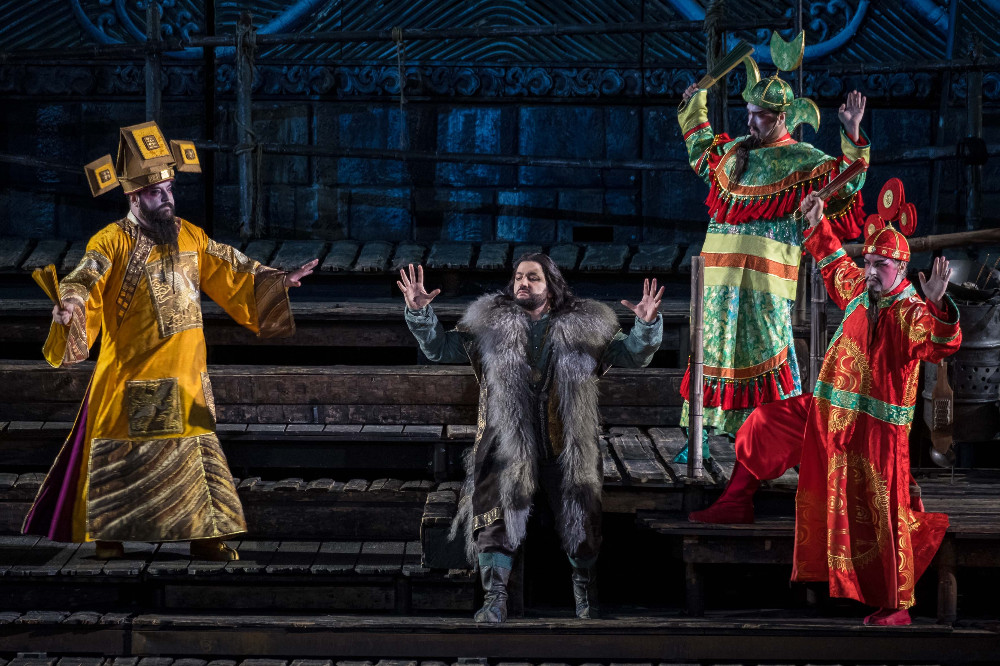
Prince Calàf and the three ministers of state Ping, Pong and Pang.
Act II
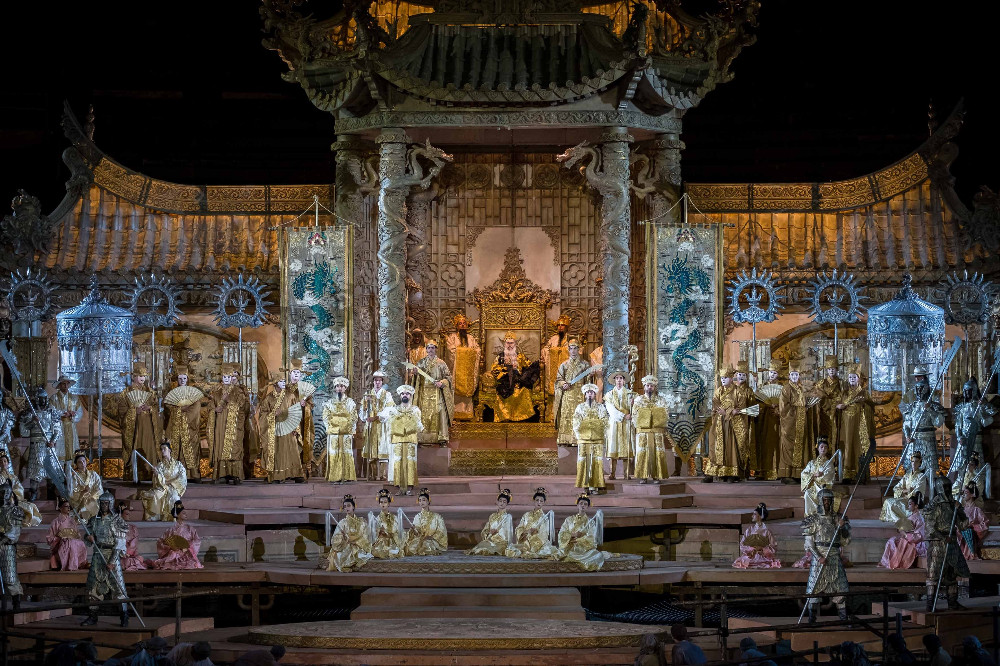
Following Ping, Pang, and Pong's reflections on conditions in China, the trial unfolds with the Emperor, Turandot's father, in attendance. Initially, the princess expresses her desire to execute all suitors to avenge the violent death of an ancestor, then poses the three riddles. Although Calàf solves them, Turandot refuses his marriage proposal. Consequently, the prince issues his own challenge: “Guess my name before dawn, and you may execute me. Otherwise, you must marry me”.
Act II
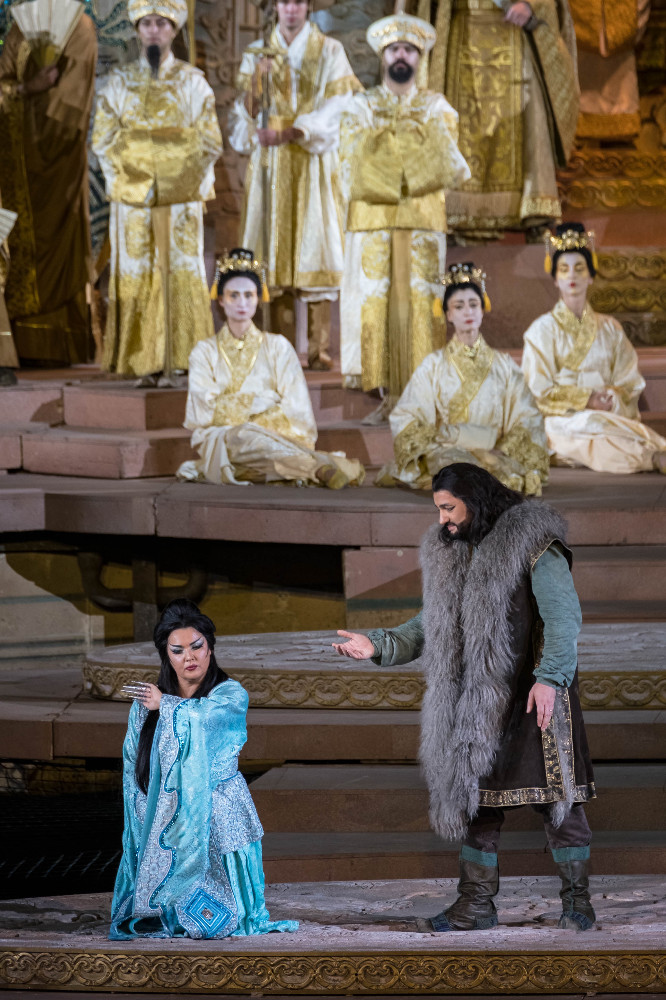
Princess Turandot.
Act III
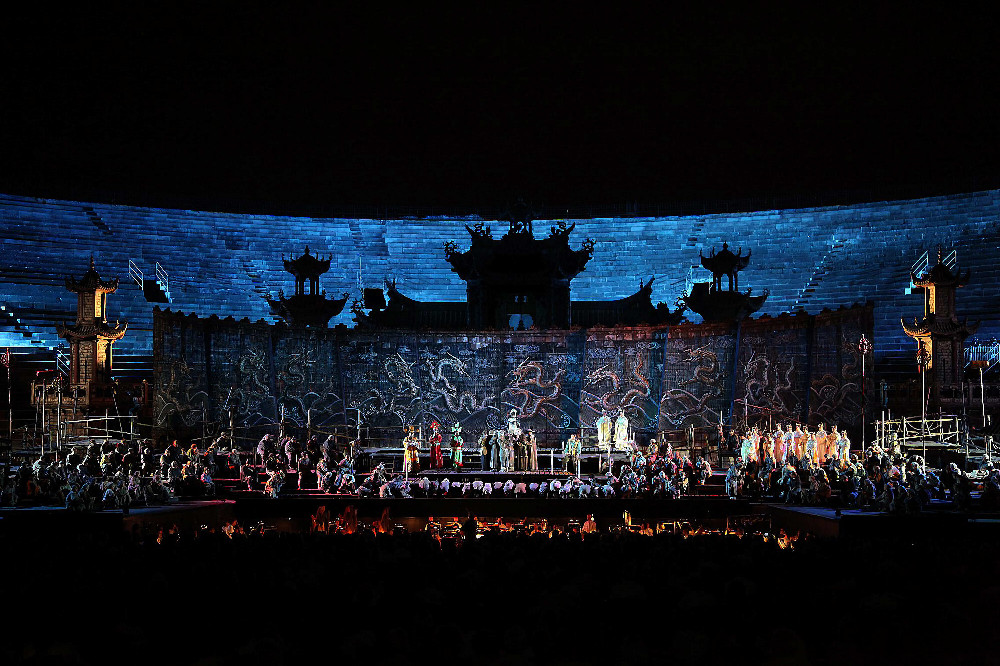
As Peking remains vigilant under Turandot's decree, Calàf waits for dawn, confident in his imminent victory. However, the ministers capture Timur and Liu. Liu chooses to kill herself in order not to divulge the secret of the man she loves. Her suicide deeply affects everyone. It prompts Calàf to confront Turandot, and he manages to kiss her and thaw her icy heart. The princess confesses to him that she has loved him from the start. Calàf then reveals his identity, leaving his fate in her hands. As the people and court assemble, Turandot proclaims the stranger's name to be “Love”. The sun rises and everyone celebrates the new royal couple.
Act III
CHARACTERS
Princess Turandot [soprano]
The Emperor Altoum [tenor]
Timur [bass]
The Unknown Prince (Calàf) [tenor]
Liù [soprano]
Ping [baritone]
Pang [tenor]
Pong [tenor]
A Mandarin [baritone]
The Prince of Persia [tenor]
The Executioner
The imperial guards, the executioner's servants, the boys, the priests, the mandarins, the dignitaries, the eight wise men, Turandot's handmaidens, the soldiers, the standard-bearers, the musicians, the shadows of the dead, the crowd.
Director’s Notes
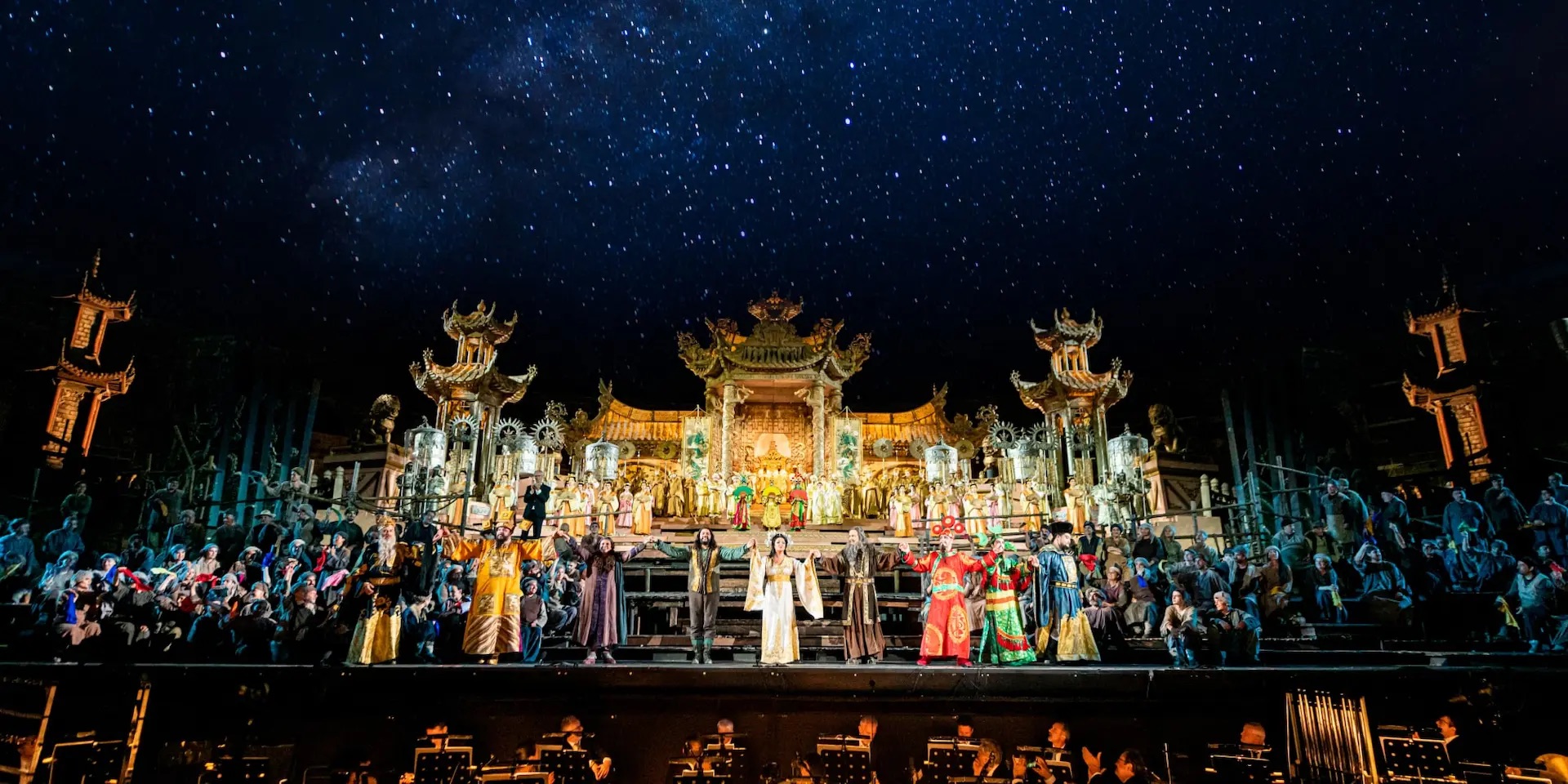
Puccini’s final opera, Turandot, was left unfinished at his death. However, perhaps due to its choral, exotic, and grandiose qualities, Turandot was the very first of Puccini’s works to make its debut at the Arena in 1928. It brings to life “the China of the time of fairy tales,” as imagined by the Veronese authors of the libretto, Adami and Simoni. The story was inspired by the tragicomic fairy tale by Carlo Gozzi. Franco Zeffirelli sets it in a China removed from time and in the geographical space of the “fantastical,” marvelous Orient. The set design works its way into the collective imagination, like the rich illustrations in old fairy tale books for children. Even after its debut in the Arena in 2010, the edition by Zeffirelli, with his directing and scenography, still catches the eye, like with the scene change that anticipates the entrance of emperor Altoum. Here, the bleak, disturbing darkness animated by the faceless crowd of the common people dressed in rags is suddenly engulfed by the light of a palace made entirely of gold with rich details that is made even more magical by the bright costumes dominated by the colors of gold and silver. In addition to the magnificence of the scenes, the direction continues to receive praise for its adept portrayal of the most pervasive and arguably most demanding character in the opera: the “people of Peking”. Throughout the production, this irrational crowd not only adds to the opulent spectacle of the scenes but also actively shapes the destinies of the main characters.
Credits
The texts and images contained in this accessible program booklet have been provided by Fondazione Arena di Verona.
Design, planning, texts and descriptions
Elena Di Giovanni, Francesca Raffi (Università degli Studi di Macerata)
Technical supervision
aXess - Associazione per l'accessibilità alla cultura
Technical design, planning and digital development:
Tadao Agency
Videos in ISL
Daniel Bongioanni
Disclaimer
Copyright in these pages is owned by Fondazione Arena di Verona except where otherwise indicated by a third party's proprietary notice. These pages and the material published on them are also protected by intellectual property laws and may not be reproduced or appropriated in any manner without written permission of their respective owners. For more information, please contact commerciale@arenadiverona.it