Aida
Accessible opera bookletGiuseppe Verdi
Aida
by Giuseppe Verdi
Opera in four acts.
Libretto by
Antonio Ghislanzoni
This is the accessible program booklet for Aida by Giuseppe Verdi.
It provides audio versions of the texts, audio descriptions, and videos in ISL,
International Sign Language. The texts can be easily zoomed in and out, and the contrast of
the display can be increased.
The “Audio text” button plays the audio of the texts read by a male voice while the “Audio
description button plays the audio descriptions of the pictures read by a female voice. The
“ISL” button plays videos in International Sign Language.
By using this accessible program booklet, you give explicit consent to accessing content
hosted on third party websites.
Synopsis
Act I
The winds of war are blowing in Memphis. Ramfis informs Radamès that the Ethiopians are readying to invade Egypt. The young warrior hopes to receive the high command of the army and appear valorous in the eyes of the woman he secretly loves – Aida. She is the Ethiopian slave of Amneris, the daughter of the Pharaoh. The Egyptian princess is also in love with Radamès and suspects that her slave is also her rival. A messenger confirms the invasion of the Ethiopians under the command of King Amonasro, Aida’s father. The Pharaoh announces that the oracle has chosen Ramadès as their supreme commander. Aida, now alone, is torn between irreconcilable emotions: she desires Radamès to be victorious and, at the same, hopes that Amonasro destroys the Egyptian forces.
Act I
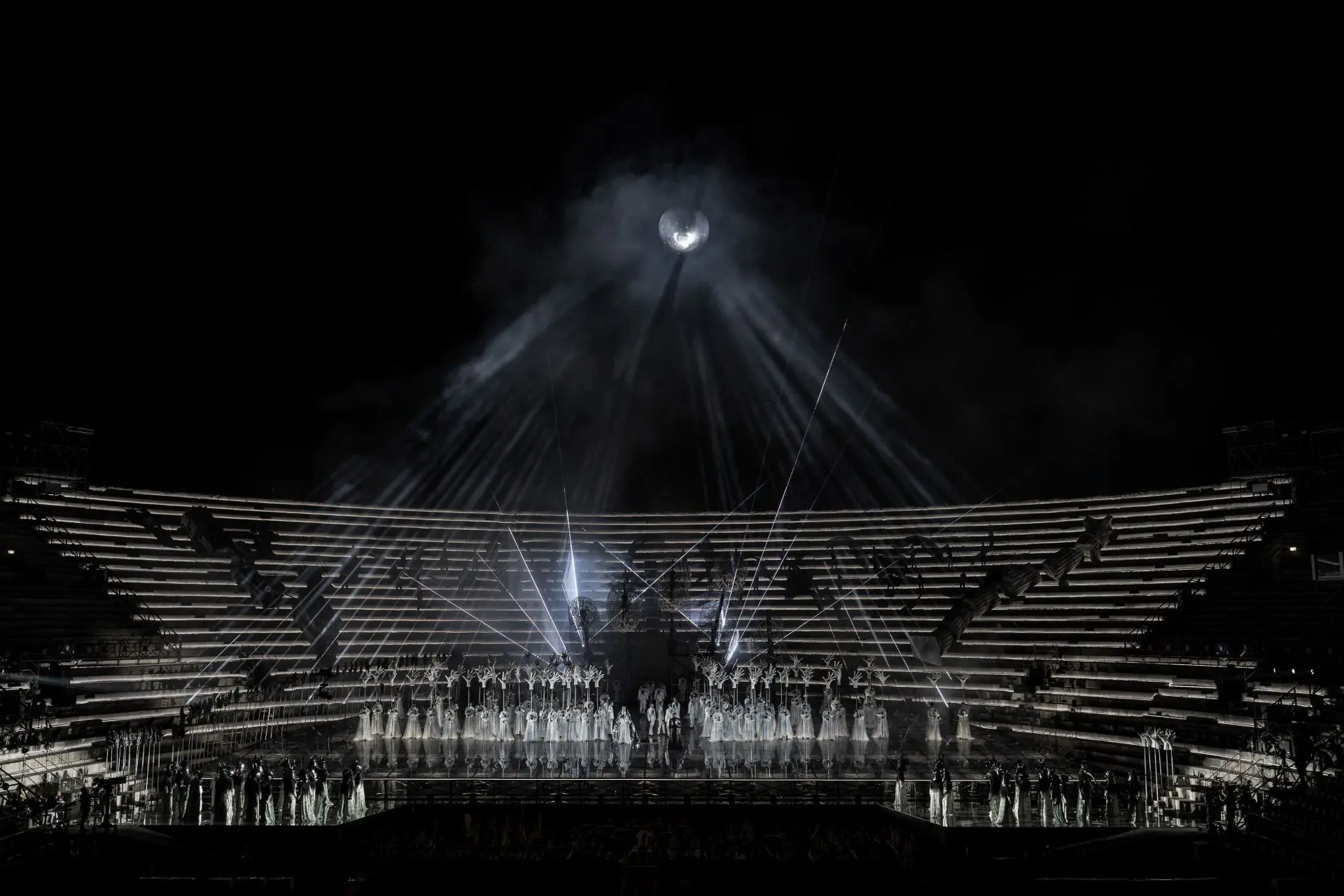
Ramfis, Radamès, priests and
priestesses.
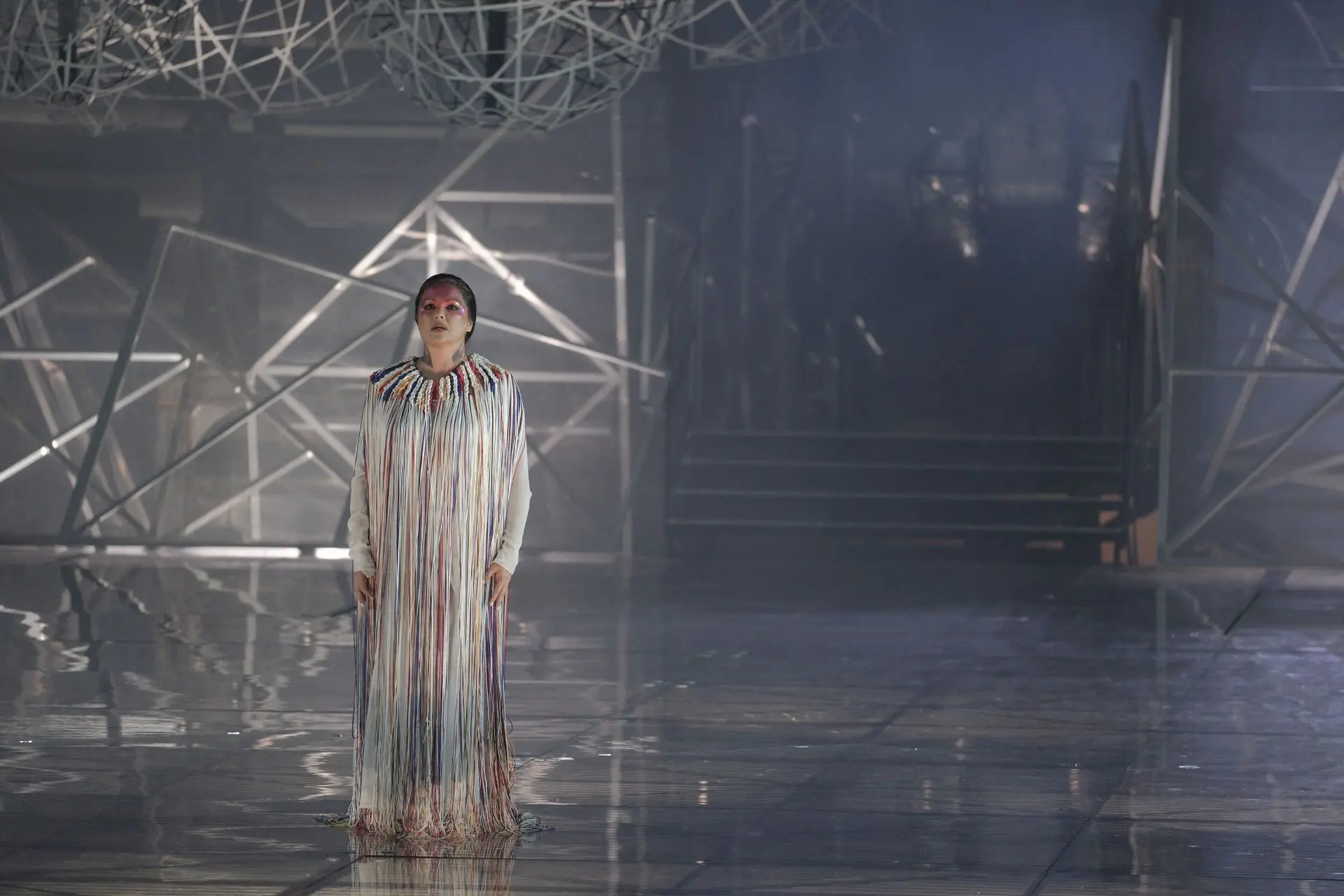
Act I
Aida.
Act II
Under the guise of friendship, Amneris puts Aida’s feelings to the test by telling her that Ramadès has been slain in battle. Aida’s desperation confirms Amneris’ suspicions. The princess unveils her deception: Radamès is alive and she too is in love with him. A short while later, a triumphal procession enters Thebes, celebrating the victorious Radamès. The king pledges to grant his every desire. The Ethiopian prisoners are also in the procession, including Amonasro, who pretends to be merely an officer and pleads for mercy for the captives. Ramfis calls for their deaths while Radamès asks for the prisoners to be freed. The king finds a compromise: Aida and Amonasro will remain in Egypt as hostages to guarantee peace, and all of the others will be set free. The marriage between the victor and Amneris is then announced.
Act II
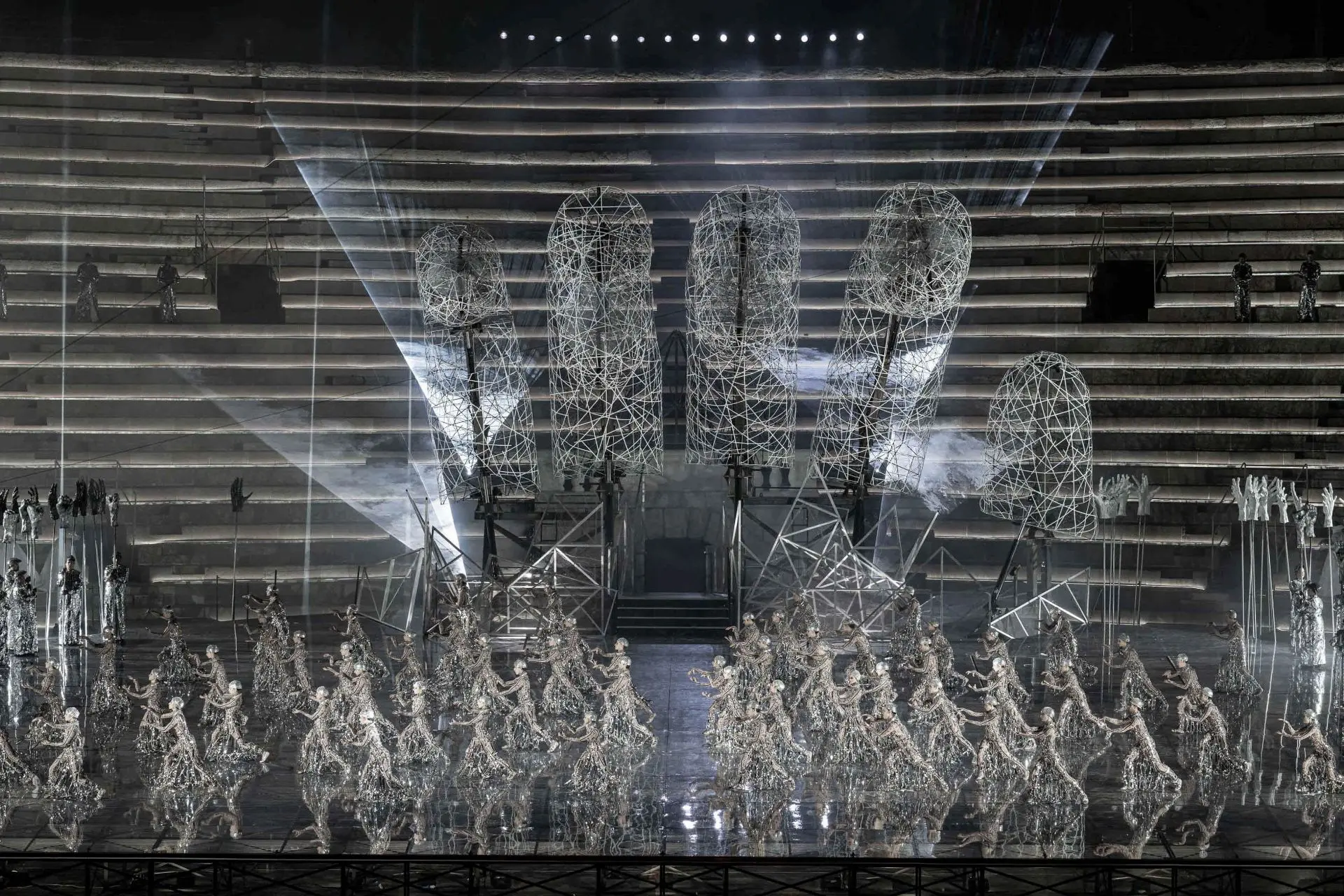
Male and female
dancers.
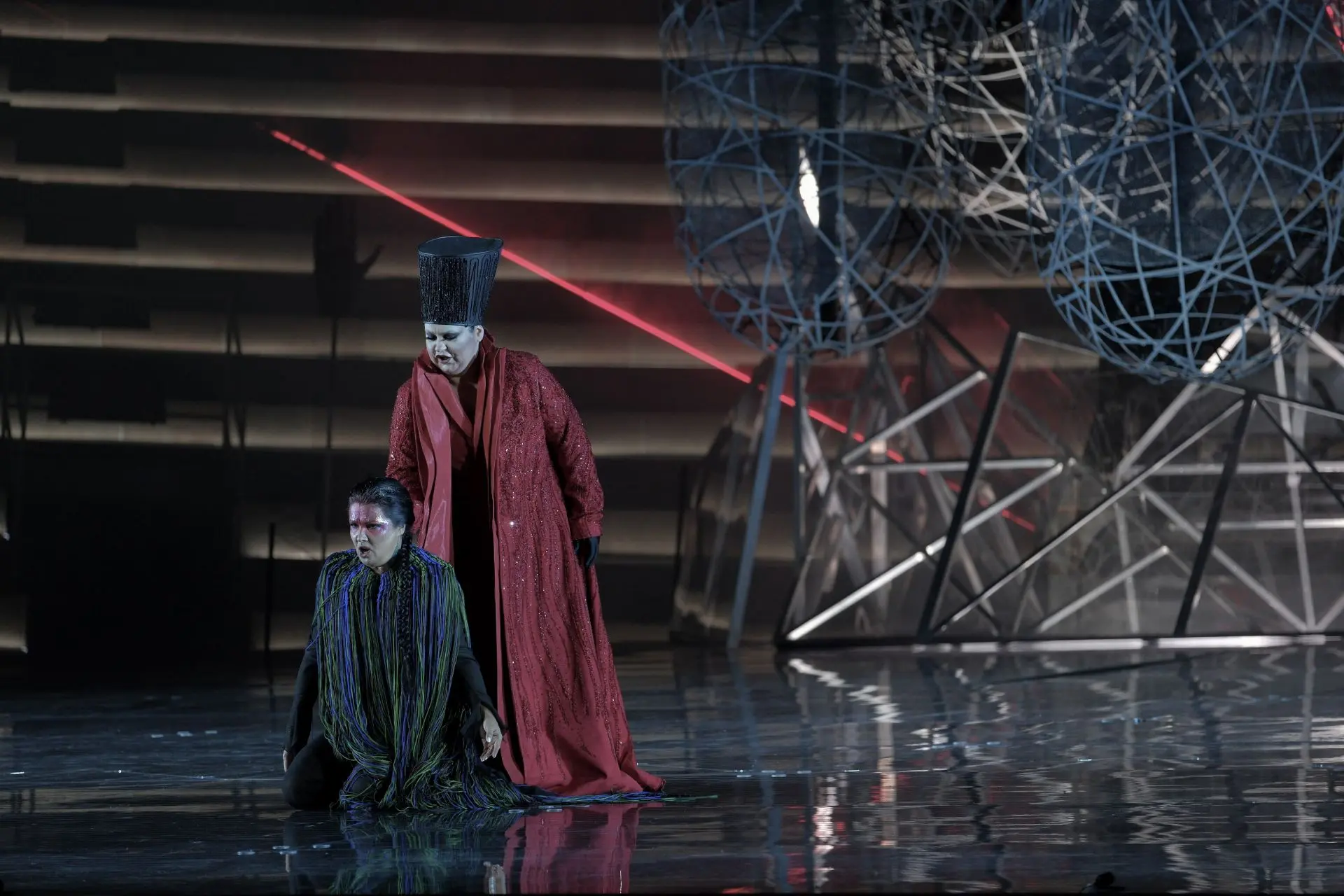
Act II
Aida and Amneris.
Act III
Amneris is praying inside the temple of Isis on the eve of her wedding. Aida also arrives outside to meet with Radamès. Amonasro appears and is plotting to ambush the Egyptian army. He has become aware of the love between Aida and Radamès, and takes advantage of his daughter’s feelings to pursue his vendetta. He promises her that she will return home but on one condition: she must make her beloved reveal the route the Egyptian forces will take. Reluctantly, Aida manages to convince Radamès, and he tells her the route, but Amonasro comes out of hiding and reveals his true identity, ruining everything. The situation escalates as Amneris comes out of the temple and cries treason. Amonasro lunges at her to kill her, but Radamès stops him. Radamès hands the sword over to Ramfis and allows himself to be arrested, while Aida flees with her father.
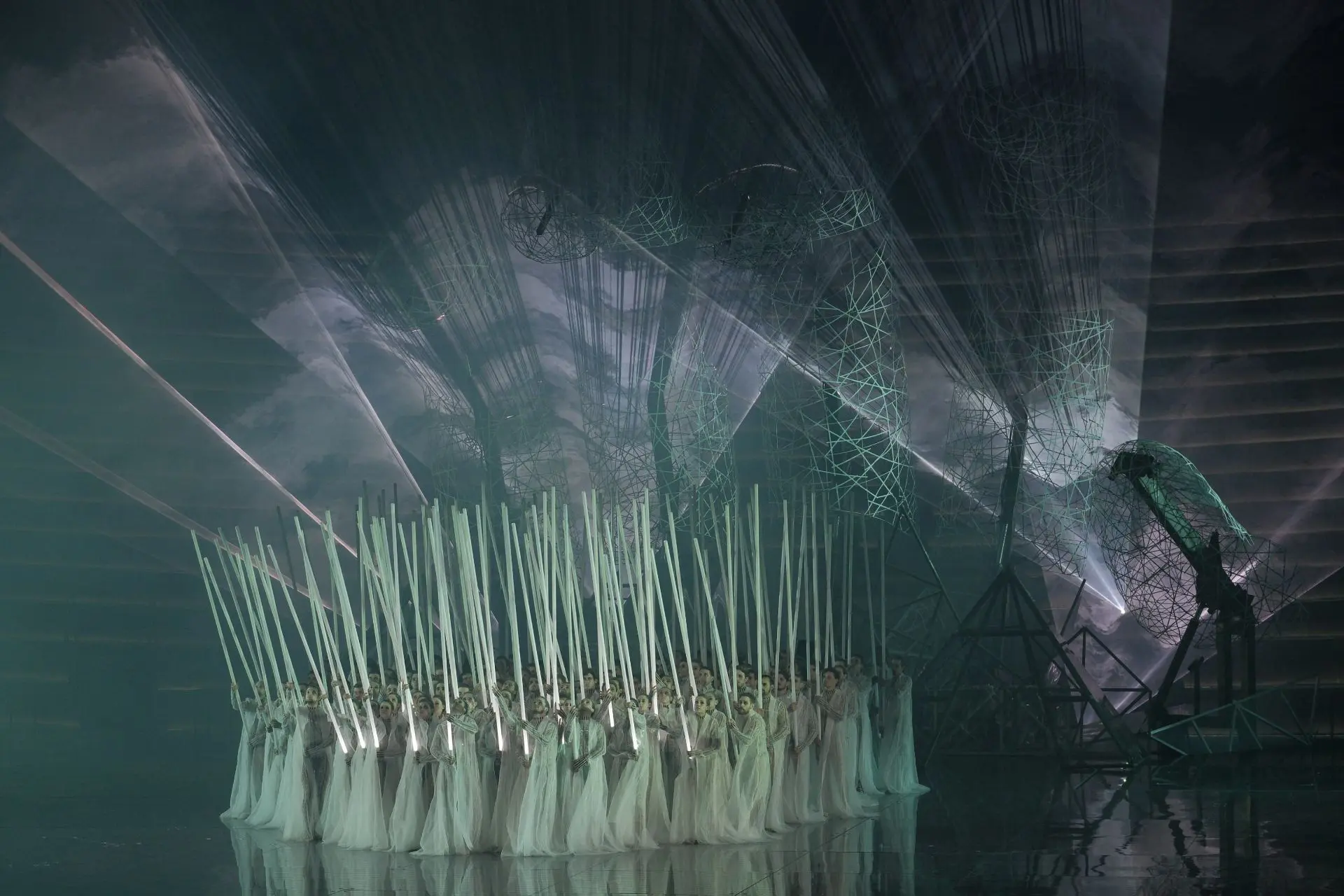
Act III
Male and female
dancers.
Act IV
With her pride wounded, Amneris is torn between her desire to save Radamès or to destroy him. She has him brought to her. She begs him to deny the accusations and she will ask for the king’s pardon. Radamès refuses, and, having lost Aida, he prefers to die. He resists Amneris’s entreaties even when she reveals to him that Aida is still alive and she promises him freedom if he renounces his love for her slave. Radamès is then led back to his prison cell, and his sentence is handed down shortly thereafter: Radamès is to be buried alive. The priests close Radamès in a vault, but Aida is there waiting for him. She slipped in unseen to die with the man she loves. Meanwhile, Amneris, defeated, prays for peace.
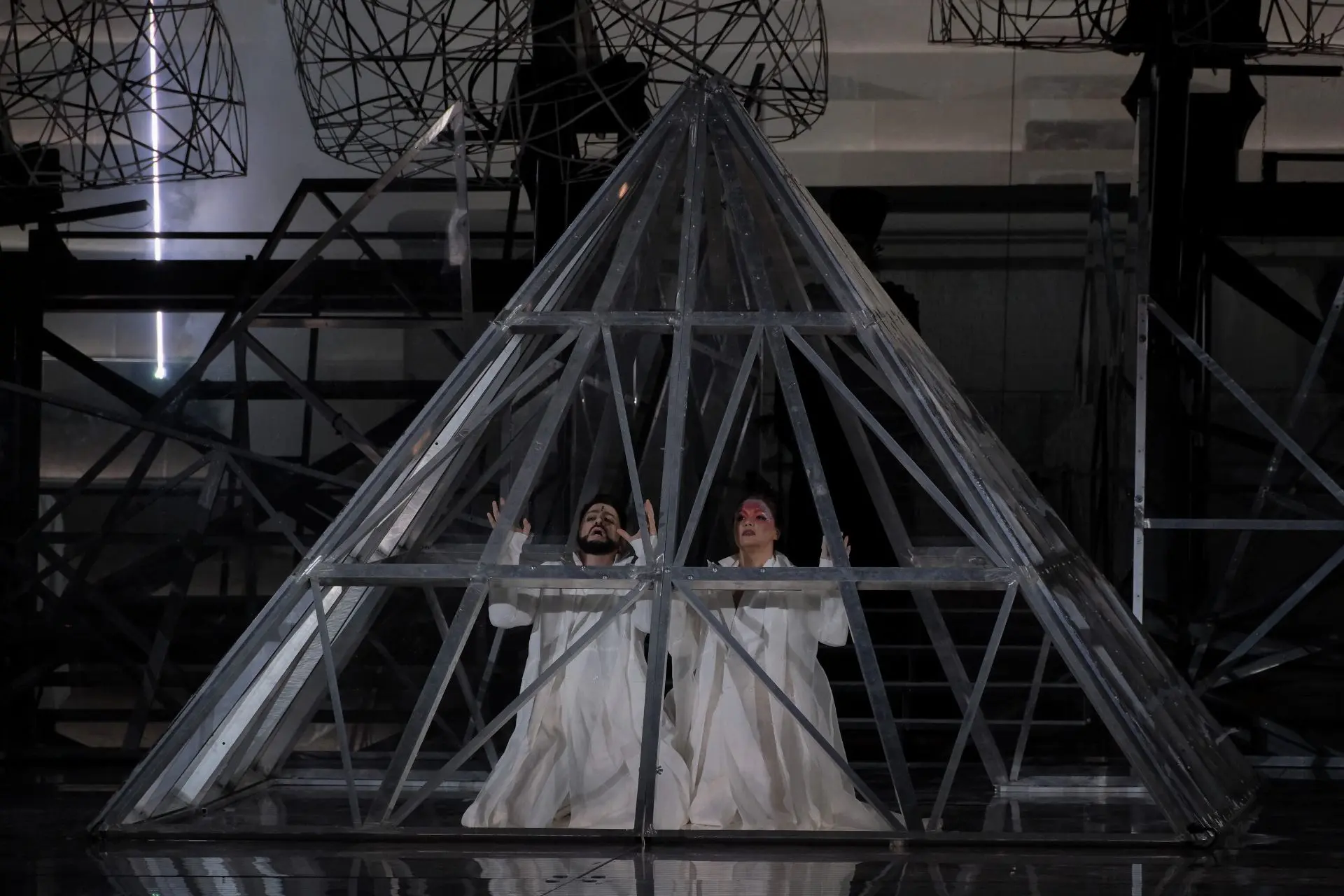
Act IV
Radamès and Aida.

Act IV
Aida and Radamès.
Characters
The King [bass]
Amneris, daughter of the King [mezzo-soprano]
Aida, Ethiopian slave [soprano]
Radamès, Captain of the Guard [tenor]
Ramfis, High Priest [bass]
Amonasro, King of Ethiopia and father of Aida [baritone]
A messenger [tenor]
High Priestess [soprano]
Priests, Priestesses, Ministers, Captains, Soldiers, Officials, Ethiopian Slaves and
Prisoners, Egyptians
Director’s Notes
The story of Aida is one of a world at war that divides two brotherly, neighboring
peoples, turning them into mortal enemies. War is, indeed, the backdrop to the
entire production, which ends, however, in a whisper for peace.
Director Stefano Poda in fact, sees Aida as “a Dantesque journey from an infernal
beginning to a finale with a celestial vision.” The beginning of the opera sets up a
series of extreme tensions and conflicts comparable to infernal perdition. The story
of the main characters is like a journey through numerous stages that ends in an
ascent towards liberation, towards a sort of paradise.
Other aspects of Aida represent polar opposites. Religion is described as an element
of profound union and, at the same time, of extreme violence. Eros and Thanatos
represent, respectively, the impulse for life and the instinct for death and
destruction.
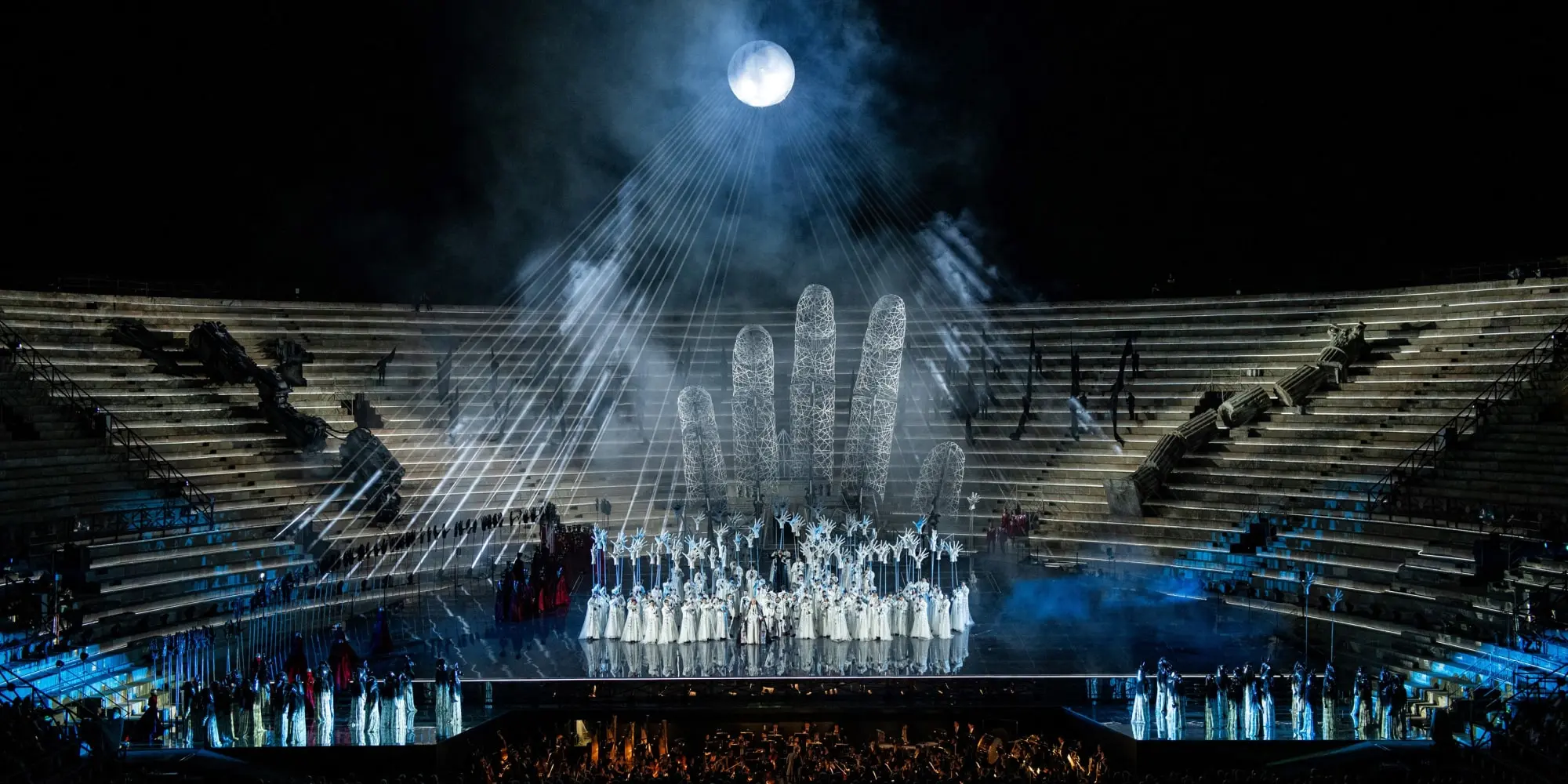
The staging designed by Poda, therefore, reflects this dualism and was conceived as
an art installation that represents a world made of steel, silver, mirrors, glass
and transparency. This world is cold and pure, ethereal and merciless, and, at the
same time, technological thanks to the use of LEDs and lasers that create virtual
pyramids. The stage is dominated by a large mechanical hand made of metal with
moving fingers. It is mounted on an inclined and reflective platform. This hand is a
monument to humanity in its highest dimension in that individuals have to decide how
to use their infinite potential – for good or for evil. It is surrounded my numerous
smaller hands that are black on the left and white on the right, all mounted on
spears. They represent the power to build and to destroy, and are used to make
sacred gestures, but also to kill. Behind the stage, a Corinthian column lies in
pieces, like ruins, on the tiers of seating to the right. To the left lies the
wreckage of futuristic machines that represent the tragic consequences of war
throughout history and the destructive use of technology.
Credits
The texts and pictures contained in this accessible program booklet have been provided by
Fondazione Arena di Verona.
Concept, planning, and adaptation of the texts and the descriptions
Elena Di Giovanni,
Francesca Raffi
(University of di Macerata)
Technical Coordination
ALI – Accessibilità Lingue Inclusione
Tecnical design, planning and digital development
Veronica Antinucci e Federica Tarchi
Voices
Marco Quaglia (texts)
Giulia Heathfield Di Renzi (descriptions)
Videos in ISL
Monika Nawrot
Translation
Michael James Zebrak
Disclaimer
Copyright in these pages is owned by Fondazione Arena di Verona except where otherwise
indicated by a third party's proprietary notice. These pages and the material published on
them are also protected by intellectual property laws and may not be reproduced or
appropriated in any manner without written permission of their respective owners.
For more information, please contact commerciale@arenadiverona.it